The Timeless Dance of Water, Light, and Chromatic Elegance
Is Venice one of those cities everyone dreams of visiting at least once in a lifetime? A romantic water-city layered with poetry and history, it remains a pilgrimage for filmmakers, architects, and designers, and for many, the stage of life’s most profound promises. Nestled in northeastern Italy’s Veneto region, Venice is the only city in the world built entirely on water. Before it yields to the tides and becomes a modern Atlantis, walking its “soft earth” fulfilled my twenty-year dream. I arrived in early October, during that golden light when summer’s fever gives way to autumnal clarity.
Having just journeyed north from the terrestrial landscapes of Toscana, the contrast is immediate. Venice is not a typical medieval stronghold, nor a land-based power of the High Renaissance. Established upon a lagoon, it developed from the 9th to the 15th century as the capital of La Serenissima, the Venetian Republic, a maritime power defined by systems, trade, and diplomacy. It flourished as a nexus for spices, silk, pigments, and, most importantly, ideas circulated between East and West. This “twilight of civilization” is a place where religions, aesthetics, and economies overlapped, and where memory, time, and the senses intertwine.
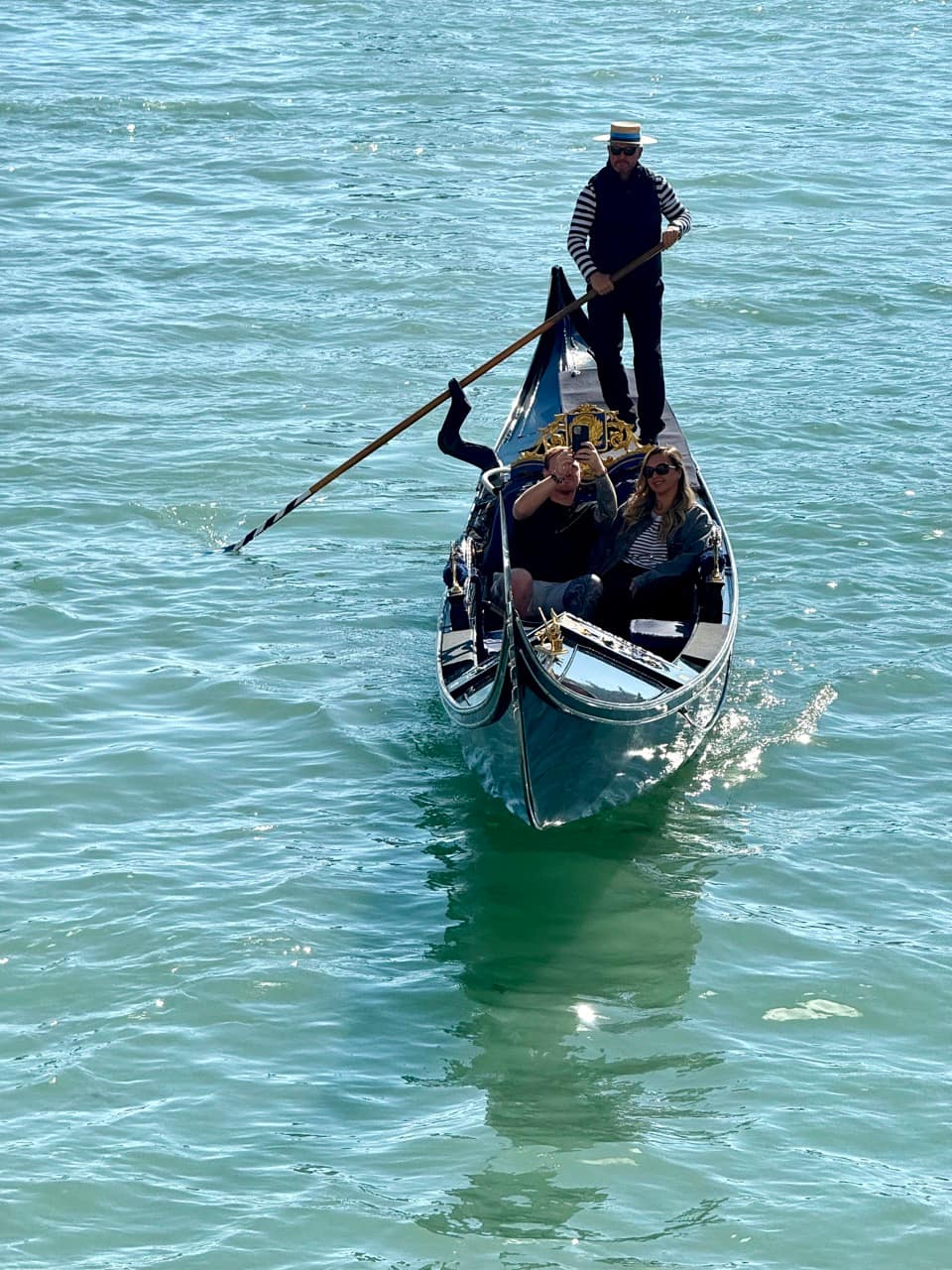
Gondola upon Bacino di San Marco
A City Moved by Water
In this aquatic labyrinth of 118 islands and 150 canals, the city’s waterways, free from motorized hum, create a rare acoustic intimacy. The Gondola, with its traditional hand-rowed black hull, offers a high sense of ceremony. For the daily pulse, there is the Vaporetto, the floating bus connecting the main islands, and the water taxis, which cut through the lagoon like speedboats from a mid-century cinema. It is this diverse watercraft that sets each passage alive with color, motion, and a dynamic charm.
With over 400 bridges, every arched ascent reveals a new horizon. Venice is a UNESCO World Heritage site that breathes through its romantic canals and magnificent masonry, a testament to a civilization that mastered the art of living between the tides. Here, “sensation precedes reason.” Unlike the Florentine obsession with disegno, the rationality of symmetry and the intellectual rigor of line, the Venetian school—Bellini, Titian, Tintoretto, and Veronese—celebrated colore. Tracing my path north from solid ground of Florence to the fluid streets of Venice, The divergent philosophies I once encountered in books have finally taken shape in lived experience. I now understand their distinct claims, witnessing firsthand how politics, economic prosperity, and the natural environment once collectively sculpt the face of culture. The artists pursued the sublime within their fascinations, and today, I capture these fragments of beauty through my eyes, tracing where their vision meets my own.
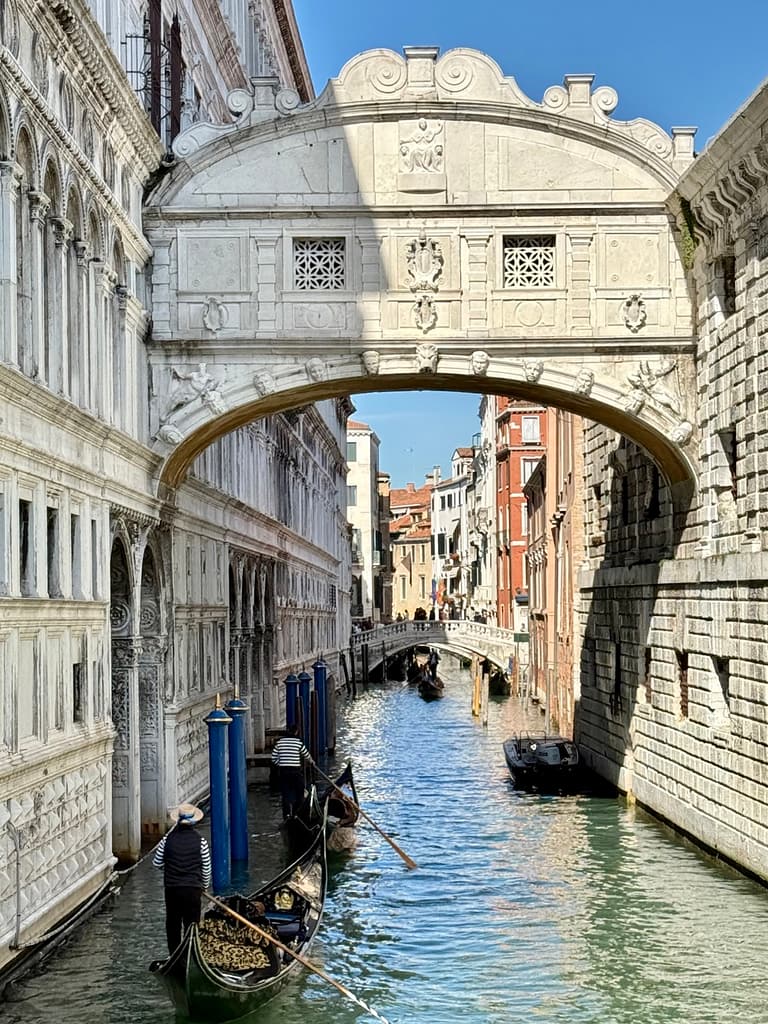
Gondola beneath Ponte dei Sospiri
Water taxi navigating the canals
Twilight along the waterways
Nightfall on the Grand Canal
Luminous Pulse upon the Emerald Flow
Walking in the city, where the streets are waterways and the alleys are arteries of stone, the humid air and the constant reflection of the lagoon necessitate an aesthetic of soft, atmospheric depth. The green water, an emerald clarity distinctive to the lagoon, serves as a liquid mirror, casting luminous patterns onto ancient masonry. Every transformation feels organic, and the same corner unfolds new discoveries with each passing hour as these shimmering ripples dance across the weathered brickwork. When wandering, the light acts as a silent, unanticipated guide, filtering through the shadows to lead my way.
Luminous patterns beneath stone bridge
Water gate and wooden pali
Light-defined passage to its opening
Light and shadow upon waterway
Ponte di Rialto & Campo San Bartolomeo
The Grande Canal sweeps through the city in a grand S curve, lined by centuries of Gothic and Renaissance palazzi. More than a waterway, it was Venice’s principal artery: a ceremonial boulevard, commercial line, and stage upon which the Republic’s global ambitions unfolded. Merchant ships from Byzantium, the Islamic world, and Northern Europe once anchored along its banks, transforming private residences into hybrid spaces of home, warehouse, and trading house. At its heart stands the Ponte di Rialto, the oldest bridge over the canal and the supreme vantage point for the city’s heartbeat.
Nearby lies Campo San Bartolomeo, the social hearth of Venice. In the center stands the bronze statue of Carlo Goldoni, the 18th-century playwright who founded modern Italian comedy. Positioned with his back to the Grand Canal, he faces the streets, observing the daily dramas of the citizenry. The pedestal, adorned with theatrical masks, reminds me that Venice is a city of performance. This is Venice at its most authentic: not monumental power, but literature, commerce, and the flowing currents of everyday life.
Visitors crowd Ponte di Rialto
Looking downstream toward San Polo
Noble palazzi along the upstream
Bronze statue of Carlo Goldoni
Piazza & Piazzetta San Marco
After traversing the shifting alleys and bridges, the expanse of Piazza San Marco finally unfolds. The horizon is dominated by the golden mosaics of the Basilica and the towering presence of the Campanile, while the Piazzetta extends like a grand stage toward the Bacino di San Marco, framed by the Palazzo Ducale and the Biblioteca Nazionale Marciana. Famously dubbed by Napoleon as “the finest drawing room in Europe,” the square remains the city’s political and spiritual anchor. Encircled by the grand, rhythmic façades of the Procuratie, its repetitive arches and delicate stonework that carries the eye ever forward. Though I was fortunate to avoid the rains and floods, water occasionally bubbled up through the pavement drains as a haunting reminder of the city’s inherent fragility. Yet, the spirit of the square remains undimmed; the cafés stay vibrant with live orchestras playing from dawn to dusk, each hour offering a different flavor of Venice’s melody and grandeur.
Piazza opens onto Basilica di San Marco
Square bears water through the drains
Piazzetta stand columns of San Todaro
Cafés and outdoor tables
Campanile di San Marco & Torre dell'Orologio
The Campanile and the Torre dell’Orologio define the skyline—one a symbol of strength, the other of intellect. The former, a red-brick sentinel towering over the piazza and visible from the waters of the lagoon, is anchored by Sansovino’s marble Loggetta at its base. Nearby, the Torre dell’Orologio offers a different rhythm. Its astrological clock, gleaming with lapis lazuli blue and gold, invites comparison to the earlier 14th-century masterpiece in Padova. At its summit, the two bronze Moors strike the great bell in a display of time’s absolute power. Yet, here in Venice, it feels anchored to the waters, less a celestial map than a navigational guide, charting the tides alongside the hours. It is the city’s solemn voice, translating the movements of the cosmos into the rhythm of the tides.
Campanile rising above the square
Sansovino’s marble Loggetta
Astrological clock, inspired by Padua
Richly refined and ornately detailed
Basilica di San Marco
The Basilica is a fever dream of Byzantine-Gothic fusion. While I stayed outside, the façade tells a story of stolen relics and divine ambition. The five arched portals, or lunettes, serve as a visual chronicle of the city’s patron saint. At the peak, the golden lion, often depicted with wings or a book, beneath the Goddess of Justice stands as a symbol of civic pride. Here, the sacredness of Byzantine gold meets the verticality of Gothic lace and the decorative exuberance of the East. I observed Romanesque columns, Byzantine mosaics, and Oriental motifs, a synthesis of cultures seldom found in Toscana. Yet, one must not overlook the northern side, facing the Piazzetta dei Leoncini. The style here is quieter, adorned with elegant geometric marble inlays and Romanesque reliefs of birds and foliage. It is a masterpiece of understated beauty, where the stone is carved with the precision of lace, offering a serene, rhythmic contrast to the explosive splendor of the main front.
Golden Lion beneath Justice
Lunettes frescoes and marble columns
Porta dei Fiori on the northern façade
Sunlight grazes the mosaic vault
Carta Gate
I never imagined marble could be transformed into such a textured “wallpaper” until I stood before the southern flank of the Basilica di San Marco, where it meets the Porta della Carta. This place serves as the grand, ceremonial threshold to the Palazzo Ducale, marking the moment when architecture shifts from the sacred to the civic. The marble inlays here are displaying a chromatic richness, and the colors of the stone reminded me of Gio Ponti’s Staircase of Knowledge at Padua’s Palazzo del Bo, a telling sign of Venice’s aesthetic influence extending across its mainland territories.
Entrance facing the Scala dei Giganti
Spolia as emblems of power
Pilastri di San Giovanni d'Acri
Walls woven from marble like tapestry
Palazzo Ducale
The Doge’s Palace is a paradox in stone—a monumental structure of pink and white marble that appears to float. This use of pink as a dominant exterior hue is a daring Venetian signature; it is rare to see such a color handled with this degree of sophistication, especially on a scale of political power. The distinctive tracery of Venetian Gothic loggias creates a sense of weightlessness, transforming stone into lace. At the southwest corner, facing the basin, the Archangel Michael watches over the Republic as its divine protector. To watch the sun sink over the Bacino di San Marco from this historic piazza, as the pink marble absorbs the dying light, is a soft, tranquil experience.
Lion of St. Mark column beside
Sunset shadows the quatrefoil openings
St. Michael guards the southwest corner
View of the palace from the lagoon
Sunset over the Bacino di San Marco
My pilgrimage to Venice was driven by a desire to see the work of Carlo Scarpa, whose ability to harmonize modern interventions with historical fabric is unparalleled. This time, I focused on two of his masterpieces, each a testament to his meticulous attention to detail and refined aesthetic sensibility that have become classics in the city.
Negozio Olivetti
Located beside Piazza San Marco, I experienced a masterclass in “detail as jewelry” here. Scarpa’s handling of floor transitions, circulation, and the language of line and color is pure poetry. This project was made by the trust of his client Adriano Olivetti, a visionary who recognized Scarpa’s genius before his fame was fully established. Olivetti sought more than a mere showroom; he envisioned a “calling card” for the company’s soul, granting Scarpa immense creative freedom and a generous budget to craft a space through a delicate, almost anti-commercial lens.
Every element reflects Scarpa’s thoughtful design: the rhythmic lines, harmonized with the soft glow of integrated lighting, and the intentional flow that guides one through the space. The interplay of stone, metal and wood is epitomized in a masterful dialogue of textures. The iconic floating staircase, crafted from local Aurisina marble, features steps joined to their brass supports. On the ground, the vibrant mosaic floor—a composition of red, blue, yellow, and white tesserae—defines the room’s flow through varying densities of color. These “shimmering tiles” do more than decorate, they echo the shifting reflections of the water outside, anchoring this modern masterpiece firmly within the Venetian cityscape.
The iconic floating staircase
Interplay of stone, metal, and wood
Eye-shaped window as a motif
Alberto Viani’s Nudo upon black marble
Fondazione Querini Stampalia
Once a noble palazzo of the Querini family, the Fondazione Querini Stampalia was bequeathed to the city in 1869. In 1949, Giuseppe Mazzariol commissioned Carlo Scarpa to restore the ground floor, long rendered unusable by the Acqua Alta. As an architect, he proposed the concept of coexistence, treating the flood not as an enemy, but as a guest. By designing a system of channels and carefully detailed recessed joints, he set the walls slightly above the floor plane. This narrow gap, accentuated with metal reveals, produces a poetic illusion of floating walls while mitigating rising damp through capillary action. From the geometric frames to the meticulously inlaid marble floors, Scarpa’s unique vocabulary is palpable, extending seamlessly into the courtyard’s layered stone platforms and water features, where the design continues to dance with the tides. I was impressed by the glass panels thoughtfully set alongside the courtyard’s stone columns, a masterful articulation of the layered threshold between the historical fabric and Scarpa’s modern gestures, leaving me lingering in admiration.
Courtyard entrance
Integration of glass and stone columns
Refined details at the water gate
Tiered fountains in the courtyard
Arsenale di Venezia & Giardini della Biennale
The Arsenale, once the epicentre of Venetian naval supremacy, is guarded by the famous stone lions looted from ancient Greece. Today, it serves as a creative laboratory for the Biennale. Although my phone ran out of battery before I could capture the Giardini, the vibrant energy of the Architectural Biennale still lingered in the air. Far from the tourist crowds, this area offers a rare, quiet moment by the canals, where the city’s industrial past meets its artistic present.
Tranquil, inviting canal
Iconic twin red-brick towers
Stone lions guarding the entrance
Virgin Mary atop the great gate
Yellow-Legged Gull
Throughout it all, the yellow-legged gulls remained my constant companions in Venice. These “citizens of the air” are as much a part of the architecture as the stone itself, at times appearing like Zen meditators in deep stillness, though far more aggressive in their pursuit of visitor’s lunch.
Bird motionless beside the waterway
Bird on the Piazza San Marco
Bird perched steadily on wooden piles
Birds atop Colonna di San Marco
Murano
Waiting for the vaporetto allowed me for only a short visit this island, yet witnessing the mastery of glassmaking—both in the Venini boutique and the nearby workshop—was profoundly inspiring. The purity of the glass seemed to distill the stillness of the lagoon, creating a subtle dialogue between material, light, and environment.
Murano is a place where fire and sand transform into liquid light, and where the shimmer of color reflects the shifting waves and daylight of Venice itself. Each piece embodies the city’s aesthetic: the movement of water, the fleeting quality of light, and the poetry of color. Though my stay was brief, the experience left a lasting impression. I found myself falling in love with Murano glass: not merely for its technical brilliance, but for a perceptive depth that I hope to explore further within this timeless craft that I know will linger long after my journey ends.
Visiting glassmaking workshop
Interior display at the Venini boutique
Glass interacting with outdoor canal
Rainbow arching across the sky
Numa Venice Forcola & Teraferma
Staying at Numa Venice Forcola, near the Cannaregio district, was a minimalist delight. Breakfast, prepared in collaboration with the nearby Teraferma café, offered a generous selection. The room was bathed in light, and the entire experience was managed digitally. Its proximity to the train station and Rialto Bridge made it an ideal base for exploration. At night, the sound of suitcases rolling over the nearby bridge became a rhythmic “Venetian lullaby,” a gentle reminder that in this city, everyone is a traveler, and every traveler is a part of the play.