Italy takes its time, and perhaps that is its charm. Seravezza, resting quietly near Lucca in Tuscany, was the first town I visited on my solitary journey—unplanned, unadorned, yet perfectly right. The town moves to the rhythm of stone and river: the Vezza winds through its streets, and old stone houses lean into the green slopes. Since the Renaissance, Seravezza, near the famous quarries of Carrara, has long been part of Tuscany’s marble tradition, once visited by Michelangelo in search of stone. Most travelers come for the Medici Palace; I, however, came for the marble.
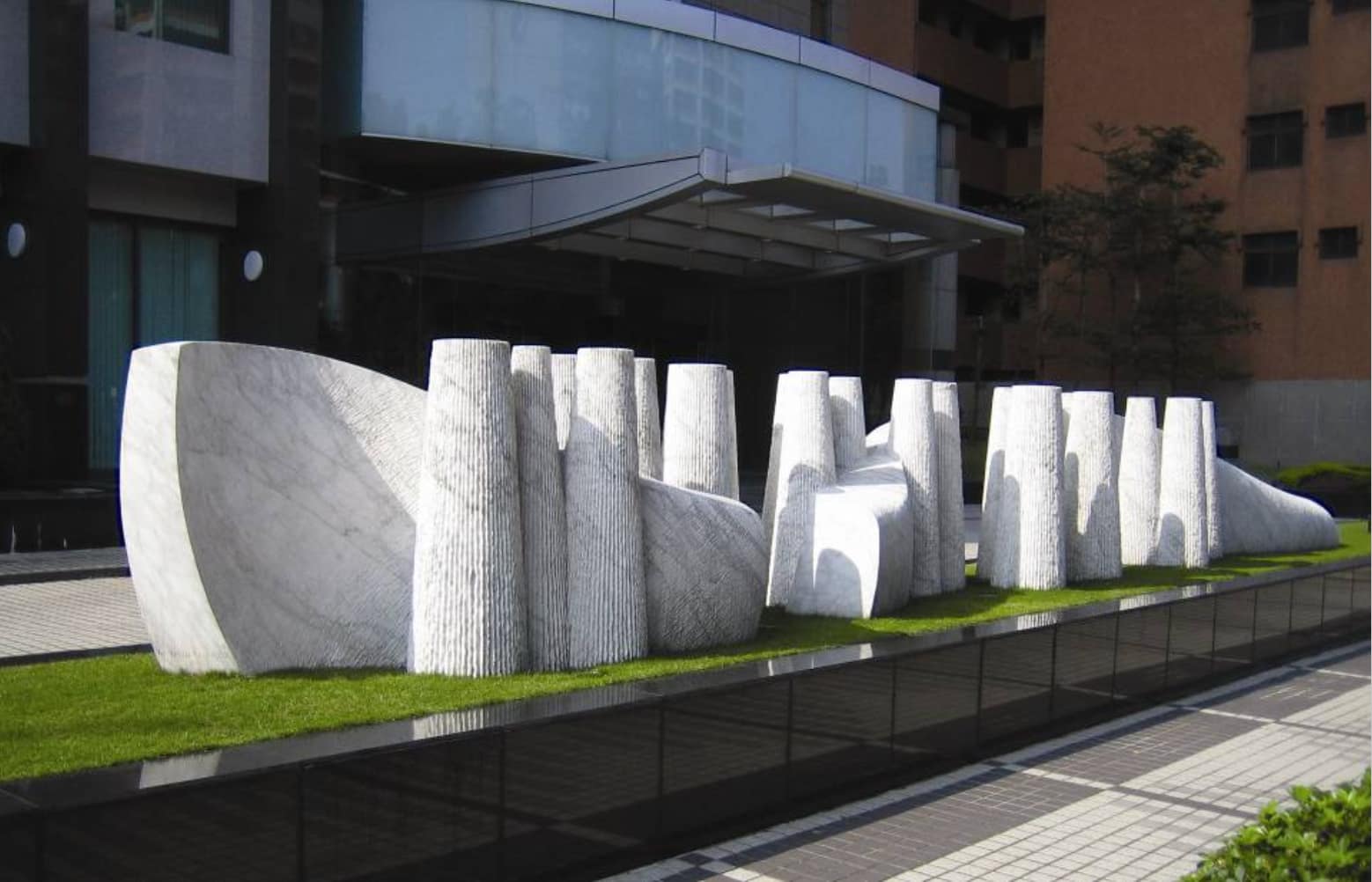
Nicolas Bertoux, The Track, 1997, Marble
Two years ago, I discovered Studio ARTCO’s catalogue on the desk of Ricky Liu, the architect of the Institute of Transportation (MOTC) in Taipei. His foundational public design project involved a collaboration with the French sculptor Nicolas Bertoux for its public art commission. This monumental installation, The Track, stands in the forecourt of the building: twenty-four Carrara marble columns, tapering like trees brushed by the perpetual motion of passing traffic, lending balance to the formality of civic institution. In the Taiwan of 1997, choosing such a work was far ahead of its time, a mark of global artistry guided by a refined, almost prophetic taste.
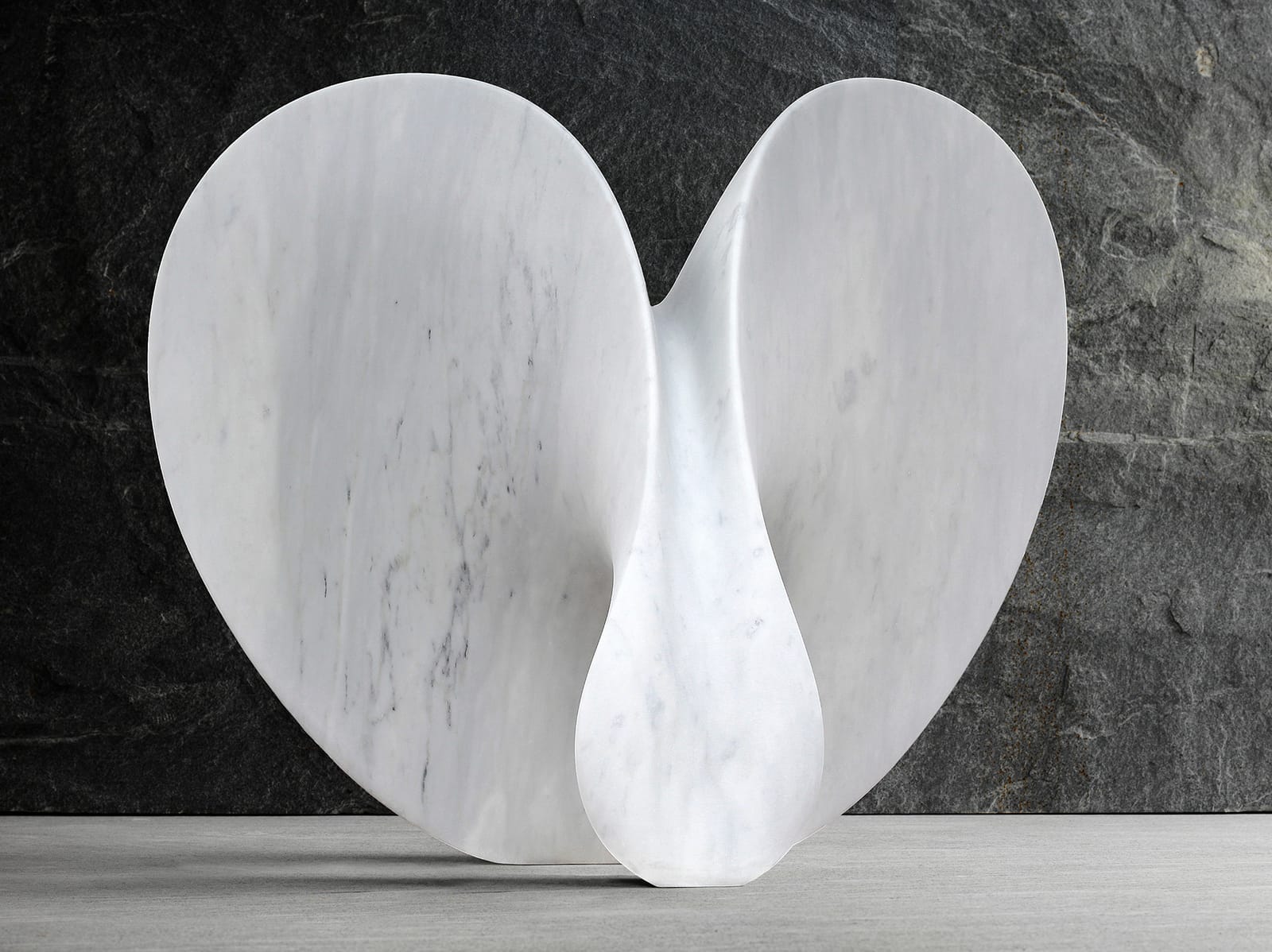
The catalogue stayed with me long after, and it was Cynthia Sah’s sculptures that continued to captivate me: white marble pieces tracing resilient grace and quiet strength, like spiritual companions. Now I found myself in Seravezza, between the slopes of the Apuan Alps and the Versilia plain, as if called here by the marble itself. Long before meeting the artists, the works had already revealed their character.
At Studio ARTCO, Cynthia and Nicolas craft marble through distinct yet harmonizing visions. Cynthia’s works carry an inherent Eastern softness—rounded, warm, peaceful, and generous. Born in Hong Kong and shaped by her years in Japan and Taiwan, her creations infuse Chinese philosophy and gently folding space around the viewer. Nicolas’s works speak differently—playful, experimental, touched with subtle humor, and at times biomorphic. With a background in interior architecture, he explores scale, proportion, and modular geometric forms in stone, allowing his pieces to inhabit spatial contexts with ease.
Cynthia Sah, Orchid, 2016, Marble
Their workshop is a place built for creation, bathed in natural light streaming through long roof windows, fully equipped for marble, wood, and iron work. Sculptors from around the world, drawn by a respect for craft, are welcome here, and adjacent apartments host resident artists. Beneath the workshop, an exhibition gallery and a stone cellar, once an ancient fish pond along the river, invite intimate encounters with the marble sculptures. The ARKAD Foundation, also established by the artists, brings life to these spaces through interdisciplinary events, where marble meets other media and creative minds, sparking dialogue across disciplines.
What impressed me most in this serene town was the artists’ openness and their refusal to close the door to new souls. This birthplace of creation is a rare meeting point of culture, nature, and life. Their works, now scattered across museums, public spaces, and private collections worldwide, possess an enduring strength, spreading beauty and inspiration wherever they go.
The studio sits by the Vezza River
Fully equipped workshop
Exhibition gallery
Residential apartments for artists
Palazzo Mediceo Seravezza
In the heart of Seravezza, Tuscany, the 16th-century Palazzo Mediceo stands as a testament to history. Commissioned by Cosimo I between 1560 and 1564, the palace served both as a fortified residence and a military outpost in Versilia, a territory long contested by Florence, Lucca, Pisa, and Genoa, prized for its marble quarries. While primarily serving as vacation spot, its frescoed walls, stone decorations, and elegant architectural details speak of a wealth that merges power with artistic sensibility. Now a UNESCO World Heritage site, the palace serves as a cultural hub for exhibitions and gatherings.
Fortified Renaissance villa
Medici coat of arms
UNESCO World Heritage site
Ground floor open as a library space
Via Michelangelo Buonarroti
The street honors the region’s historic ties to marble and its significance during the Renaissance. From 1518 to 1520, commissioned by the Medici family, Michelangelo visited Monte Altissimo to select marble. To transport the stone to the coast, a passage was carved through the mountains, carrying the blocks through Seravezza down to Forte dei Marmi, from where they were shipped to Florence and Rome.