The Frozen Time of Quiet Dignity and Understated Grace
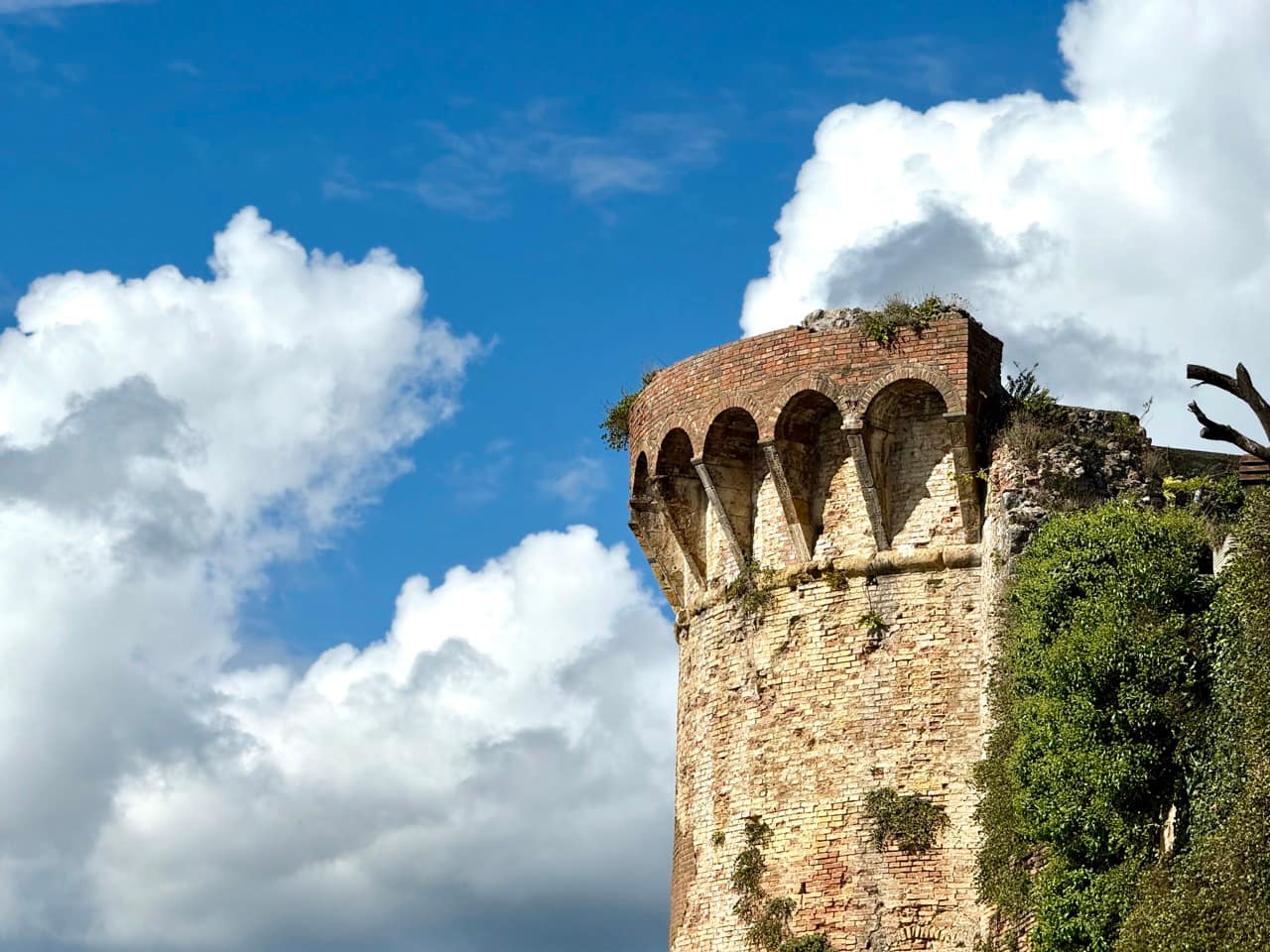
View from Porta San Giovanni
Leaving Siena on the bus with the kind guidance of a local youth, I journeyed toward this hill town I had known as the “Medieval Manhattan.” Yet, beneath the famed stone skyline of San Gimignano lies a history rooted in its strategic location, once a thriving commercial center and a vital sanctuary for pilgrims on the Via Francigena. Though San Gimignano and Siena both eventually succumbed to Florentine rule, they followed different paths to surrender. While Siena fought a fierce, century-long battle to maintain its republican identity before falling in 1555, San Gimignano yielded much earlier in 1353, exhausted by the Black Death. Consequently, where Siena remains a living, breathing medieval spirit, San Gimignano stands as a medieval city whose development was frozen in the 14th century, leaving its silhouette preserved in a state of stillness.
Piazza della Cisterna
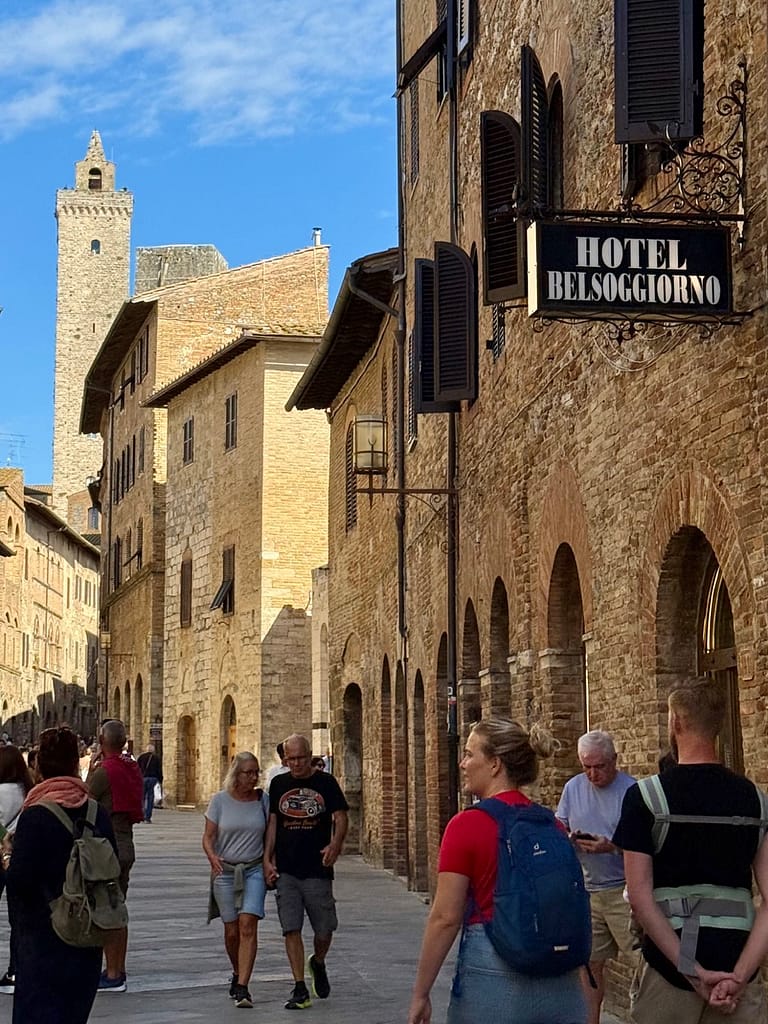
Entering through Porta San Giovanni and walking up the spine of Via San Giovanni, the air felt distinctly different. The streets were clean, bright, and the sandstone façade of the buildings possessed a certain clarity. Unlike Siena’s warm-hued palette, the atmosphere here is luminous yet grounded. After passing beneath an archway beside Torre dei Becci, I reached Piazza della Cisterna. Standing before the 13th-century octagonal well, the town’s quiet temperament persuaded me to stay; I was fortunate to find a room overlooking this very triangular stage. This town is intimately scaled, here one can wander with a sense of ease.
Via San Giovanni
Octagonal well anchors the square
The façade of the tower
Archway beside Torre dei Becci
Piazza Duomo & Loggia del Comune
At Piazza Duomo, the town’s architecture shifts from the residential to the monumental. The square is dominated by the Duomo (the Collegiate Church), which sits atop a broad stone staircase. During my visit, a wedding barred my entrance to the Cathedral, turning my gaze to the crowds resting on the steps, where pigeons rose and fell upon the ancient stone. Before ascending the Torre Grossa, I lingered within the Loggia del Comune. It is a place where officials once addressed the citizens. Here, the stone walls serve as a vivid heraldic map, encrusted with the vibrant coats of arms of past podestà. I found myself drawn to a particular fresco: a lion clutching three roses, a reminder that power should serve the ideals of virtue and order. Punctuated by the raw texture of the adjacent brickwork, this heraldic beast felt like a silent witness to the civic proclamations that once echoed through these arcades.
Piazza Duomo
Duomo di San Gimignano
Loggia del Comune
Lion with three flowers
Torre Grossa
Later, I climbed the 54-meter tower just as a soft rain began to fall. It has become a recurring echo of my journey: rain has greeted me atop the towers of Pisaand Siena alike. True to the city’s 13th-century decree, no other tower in San Gimignano rises higher than this one. It is a vertical symbol of civic authority over private ambition. Yet, under gathering clouds, the Tuscan hills took on a muted, velvety softness. From this height, the other towers are no longer distant icons but intimate neighbors; one can see the very detail of the medieval masonry just a length away. Surrounded 360 degrees by the rolling green of olive groves and vineyards, I found a solitude I had not experienced elsewhere in Italy.
The tops of other towers
Private space beneath the tower
The bell tower
Looking along Via S. Matteo
Camera del Podestà
Descending from the heights of the tower into the Palazzo Comunale, I made my way to the Camera del Podestà. Here lies perhaps my most cherished discovery: Memmo di Filippuccio’s secular frescoes. In a world dominated by religious iconography, these “Scenes of Love and Initiation” offer a rare window into medieval private life. These walls read like a novel on the ethics of matrimony and desire, while the right wall depicts the intimate, domestic scenes of a couple bathing and sharing a bed, the central frescoes serve as a counter-narrative of “ideal” love, with one particular scene engaging in a fascinating dialogue with Dante Alighieri, who famously immortalized the tragic passion of Paolo and Francesca. These frescoes were designed to remind the city’s ruler of his domestic and civic duties.
Scenes of a man’s fall
Scenes of ideal married life
Holding holm oak as protection
Arms of Agostino Migliorini Podestà
Pinacoteca
In the civic art gallery, a rich artistic dialogue between Siena and Florence unfolds. Beyond the masterpieces of Filippino Lippi’s Annunciation, I found Pier Francesco Fiorentino’s Madonna and Child between the Saints Justus, Bishop, Thomas, and the Donor Tommaso Cortesi particularly drew my attention. To the right stands Saint Thomas Aquinas, the medieval philosopher who championed the harmony of faith and reason, holding both his theological book and a miniature model of the city, portraying the saint as a protector of both spirit and stone. There is a delightful touch of medieval humor at the Virgin’s feet, where the donor, Tommaso Cortesi, is depicted as a humble figure. The presence of facing, delicate white tissue paper applied by restorers to stabilize flaking pigments, served as a reminder of the fragility of these treasures. Passing beneath the archway, the decorative frescoes with their rhythmic patterns and bird motifs, deeply influenced by the Sienese school, felt like a bridge between the natural world outside and the curated sanctity within.
Inside the civic art gallery
Decorative frescoes with bird motifs
Pier Francesco Fiorentino’s work
Saint Thomas Aquinas and the city
Sala di Dante
Finally, I entered the Sala di Dante, where Dante had once addressed the assembly as an envoy in 1300. The hall is dominated by Lippo Memmi’s Maestà, a homage to Simone Martini’s masterpiece in Siena. Yet, I found myself more captivated by the surrounding frescoes bathed in a deep blue. The hunting scenes and the depictions of knights on horseback possess a whimsical quality; the details are varied and vivid, providing a spirited contrast to the formal, seated rows of council officials portrayed on the central wall. Meanwhile, the horizontal lines of coats of arms belonging to various communes served as a constant reminder to the presiding officials of their civic responsibility.
Historic hall for city council gatherings
Frescoes depicting scenes of battle
Thoughtful use of varied colors
Frescoes like an open picture book
As I walked through the streets in the evening, I became aware that San Gimignano’s stone towers and its frescoes are the high-quality remnants of a civic life that chose to freeze in time rather than fade in struggle. It is no wonder this city is protected as a UNESCO World Heritage site. While photographs can document the height of the architecture and the facts of its construction, only by being here can one truly absorb this tranquility. I have unexpectedly fallen in love with this place, where my nature meets the profound stillness of its scenery.
Hotel Leon Bianco
Perfectly positioned within a beautifully restored historic building, Hotel Leon Bianco thoughtfully retains its original timber-beamed ceilings and ancient stone walls, just steps from Piazza della Cisterna. The interior is elegantly decorated, offering rooms that are both spacious and serene. The breakfast was generous, served on a lovely outdoor terrace. I felt truly fortunate to have a room here upon arrival.