Heritage Craftsmanship, Vibrant Design, and Global Vision
Milan is more than a gateway to Italy. Long before it became synonymous with fashion, it stood as a Roman stronghold, a medieval power center, and eventually, the industrial engine of modern Italy. Often regarded as a “shopping capital,” Milan is sometimes thought to lack the historical weight of cities suspended in time. However, returning here after the storied landscapes of Toscana and Veneto, I felt the city’s contemporary vitality, a design energy that weaves the past into future, carrying Milan’s handcrafted heritage through a vibrant, globally connected design industry.
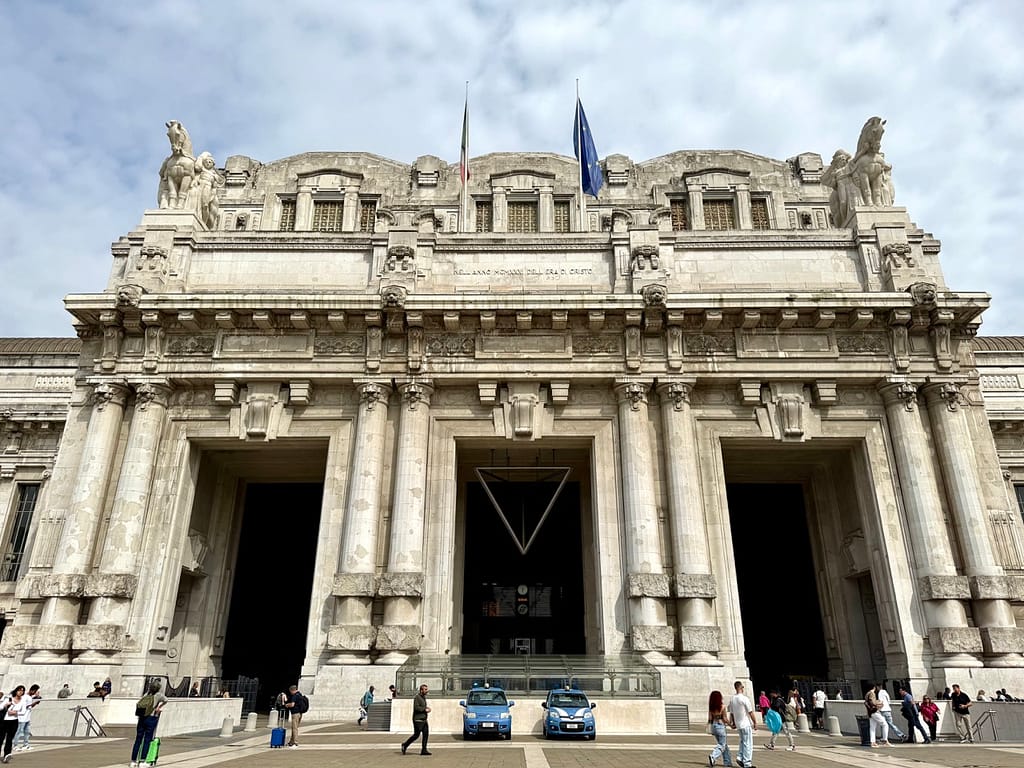
Milano Centrale
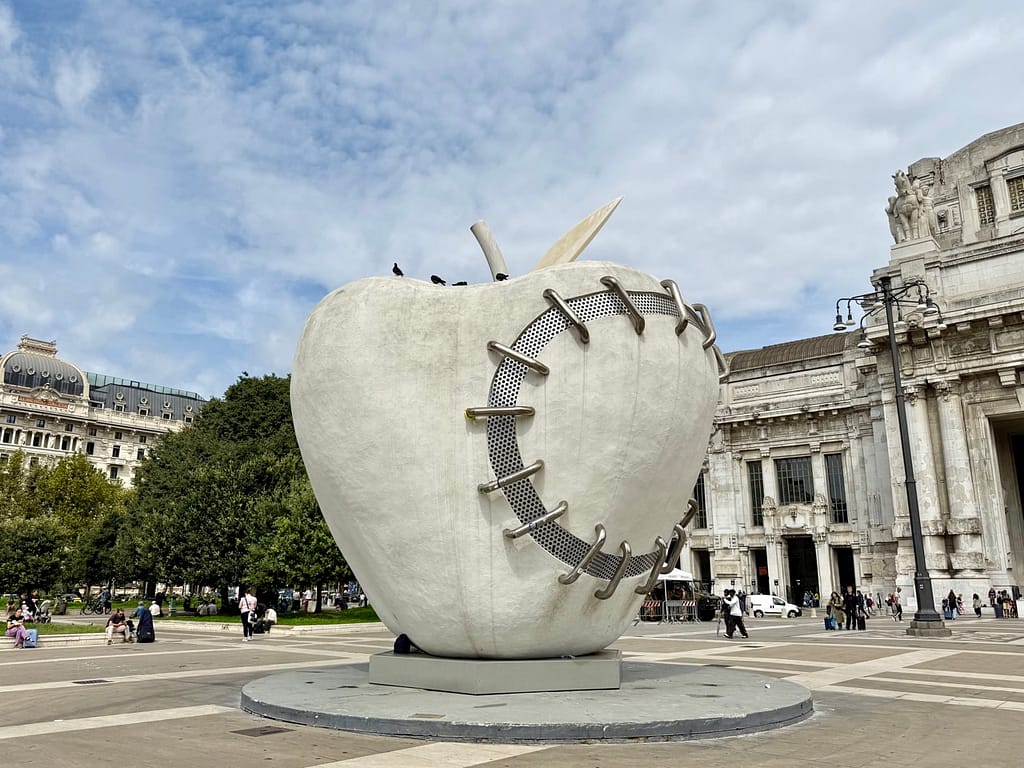
Opened in 1931 and designed by architect Ulisse Stacchini, the station connects Milan to Rome, Venice, Turin, and across borders toward Switzerland, France, and beyond. Not only a transit hub, it is a monumental statement of ambition. Its architecture—colossal stone masses, heroic stairways, and muscular Art Deco details—embodies the tension between classical grandeur and modern speed. Stepping outside, the atmosphere shifts as an unexpected installation introduces Michelangelo Pistoletto’s La Mela Reintegrata. The giant “patch” on the apple symbolizes the repair between the natural and artificial worlds, offering a poetic counterpoint to the station’s rigid grandiosity. It is a reminder that Milan’s artistic significance reaches far beyond its historic core, unfolding within the textures of urban life.
Monumental façade of the station
Pistoletto’s La Mela Reintegrata
Stone walls and sculptural reliefs inside
24 tracks of European connectivity
Apple Piazza Liberty
Walking toward the historic center, I made my way to the Apple Piazza Liberty, a familiar yet expressive presence of new technology echoing the bold artistic gesture of the Apple installation at the train station. Designed by Foster + Partners, the project sinks below ground, preserving the openness of the piazza. A glass fountain wall mediates between street and interior, transforming retail into an urban experience. In this luminous box of light and water, architecture recedes rather than dominates, an approach that resonates with Milan’s sophisticated design ethos, where innovation is often revealed through the grace of restraint.
Architecture blends into its context
Crystal fountain wall
Steps engaging with outdoor space
Piazza open to the public
Piazza del Duomo
At the heart of the city stands the Duomo, a visual symphony of Candoglia marble that took nearly six centuries to complete. Commissioned in 1386 and gradually evolving through Gothic, Renaissance, and Neo-Gothic interventions, this sanctuary embodies Milan’s enduring civic ambition and spiritual devotion. The profusion of tiny sculptures on the Duomo’s façade transforms stone into a living tapestry, narrating faith and civic pride in delicate detail, while its forest of pinnacles and statues rises with an intensity unmatched elsewhere in Italy, crowned by the golden Madonnina watching over the city. Nearby, the Museo del Novecento and the former Royal Palace frame the piazza with layers of artistic memory, as museums, arcades, and commercial streets intertwine, offering Milan’s most charming paradox, the sacred and the profane existing in a single breath.
Duomo di Milano
Over 3,400 statues sculpted
Museo del Novecento
Galleria Vittorio Emanuele II
Galleria Vittorio Emanuele II
Adjacent to the cathedral, the Galleria Vittorio Emanuele II, often called Milan’s drawing room, was conceived in the 19th century as a covered passage for commerce, culture, and civic life, now unfolding as a grand salon of Milanese elegance. Beneath its glass-vaulted arcades, historic cafés and luxury maisons frame a choreography of movement, where visitors promenade on mosaic floors in pursuit of style. Emerging at the far end, the statue of Leonardo da Vinci in Piazza della Scala stands guard. A resident genius for two decades, he remains here not as mere ornament, but as an intellectual anchor honoring Milan’s legacy as a city of scientific and artistic invention.
Iconic glass-vaulted arcades
Prestigious boutiques line the galleries
Refined and detailed interiors
Statue of Leonardo da Vinci
Basilica di Santa Maria delle Grazie
Even without a ticket in hand, I found myself tracing the presence of Leonardo’s legacy. Before reaching the main façade, I encountered Donato Bramante’s elegant cloister, where symmetrical proportions and rhythmic arcades compose a serene Renaissance harmony. Its Lombard Renaissance character emerges through warm brick surfaces and restrained ornamentation. Beyond this austere exterior lies the refectory that houses Leonardo’s Last Supper. As I lingered in the square outside, children were playing freely, and a young boy carefully painting the white surface of his shoes with colored pens. In that moment, I witnessed the most elemental form of creativity. Life inventing itself in the present moment, coexisting with the weight of history.
Lombard Renaissance façade
Ornamental pilaster shaft
Boy coloring his shoes
Chiostro delle Rane, the frog cloister
Triennale di Milano
Crossing Parco Sempione, I arrived at Triennale di Milano, a longstanding platform where architecture, design, and contemporary thought intersect. Upon entering, I was drawn to Donna seduta by Leone Lodi, a stone figure whose archaic weight and stillness anchor the building’s historical gravity. From this monumental greeting, my visit flowed into the intimate world of Casa Lana, the meticulously reconstructed private interior designed by Ettore Sottsass in the 1960s, now housed within the Sala Sottsass. This “home within a home” is organized around a central wooden furniture core, set in deliberate tension with the surrounding Clay Corpus. Within this dialogue between architectural construct and primal matter, the earthy presence of clay softened rigid boundaries, reconfiguring my sense of dwelling.
Main entrance
Donna seduta, 1933
Clay Corpus as earthly presence
Triangle stands as human will
Pinacoteca di Brera
In 2025, shortly before my arrival in Italy, I learned of the passing of fashion icon Giorgio Armani. At the Pinacoteca di Brera, I chanced upon a commemorative exhibition dedicated to the master. Seeing his garments juxtaposed with classical masterpieces was a masterclass in harmony, blurring the lines between fashion and fine art. Here, architecture, lighting, and couture coalesced into a singular vision. The iconic “Armani Gray” resonated perfectly with the oil paintings. The mannequins stood as both spectators and performers, figures suspended between the stillness of the Renaissance and the rhythm of the runway. It was a reminder that in Milan, fashion is never superficial; it is a living extension of art history, resonating across centuries.
Giorgio Armani exhibition 2025
Handcrafted black lace dress
Armani Gray woven into paintings
Figures who watch as they are watched
Urban Wit and Experiments
Milan reveals itself through subtle humor and lived intelligence. At Biblioteca degli Alberi, contemporary green architecture Bosco Verticale unfolds as a civic landscape of experimentation, offering a masterclass in sustainable urbanism. Yet, Milan’s elegance is always balanced by its edge. In the heart of the financial district, I encountered Maurizio Cattelan’s L.O.V.E., the infamous middle finger defiantly facing the Stock Exchange. It is a Milanese moment of satire, a bold critique frozen in marble. At the Casa degli Omenoni, tension is no longer satirical but structural, expressed through monumental bodies that echo the Renaissance belief in human strength as the foundation of civilization. The massive stone giants, strained and immobile, transported me back to the raw forces that have long shaped art history. In this city, corners reveal a vibrant interplay between permanence and protest.
Contemporary green architecture
Grand stage for Italy’s flavors
L.O.V.E. at Piazza degli Affari
Great Men at Casa degli Omenoni
Narratives Carved in Stone
Extending the impression left by the Duomo’s sculpted surfaces, I find myself repeatedly drawn to the city’s building façade, where narrative detail is carved into stone, reliefs and allegorical sculptures embedded in the architecture. These symbolic figures transform Milan into an open-air archive, where timeless monumentality coexists with clean modern lines, giving rise to a distinctly Milanese intelligence—measured, articulate, and enduring.
Relief on the Palazzo del Toro
Exterior clad in travertine
Pyramids at Palazzo Mezzanotte
Relief on the Piazza Edison
Milanese Androne
The city’s most moving designs are often hidden in its entryways. This liminal space, L’androne, between public and private life, once welcomed horse-drawn carriages into noble courtyards. More than circulation, it performs a symbolic passage: a tempered release from the city’s intensity into domestic calm. Today, these portals endure as architectural spaces where dignity, privacy, and social order are rehearsed before one enters the inner world of Milan.
Palazzo Sola Busca
Building on Corso Venezia
Building on Via Gabrio Serbelloni
Building on Via Gabrio Serbelloni
Via Monte Napoleone
Paper Moon Giardino
My final night in Italy was spent with a friend at Paper Moon Giardino. In this exquisitely designed restaurant, we dined al fresco in the courtyard, savoring the sweetness of the seafood as conversation flowed and time softened around us. Just steps from Via Monte Napoleone, at the heartbeat of Milanese luxury, I felt grateful to my friend for bringing me here, a moment truly worth commemorating.