Florence, in central Italy, a name etched into my mind, has long commanded both wonder and reverence. It is the cradle of the Italian Renaissance—the city where the humanist ideal was reborn and first articulated into stone and shadow. Through years of art history study, I had constructed a theoretical Florence, a map of styles and dates that remained suspended in thought until the moment I arrived. Stepping off the train, the transition from abstraction to reality was visceral; I could hardly believe the pavement beneath my feet was the same that had once carried the weight of the history I had admired from afar.
Walking along Via de’ Cerretani toward Piazza San Giovanni, the urban fabric suddenly gives way to the Baptistery and the Cathedral of Santa Maria del Fiore. They rose before me—immense, commanding, and overwhelming in scale. Even as I stood here, absorbing the magnitude of the marble façades, imagination and reality refused to fully converge. I found myself suspended in an in-between state, perhaps this sensory intensity often called Stendhal syndrome: a state where the soul struggles to keep pace with the eyes. It occurred to me that a fulfilled dream does not always declare itself; sometimes it arrives in a profound silence, leaving one unsure of how to respond.
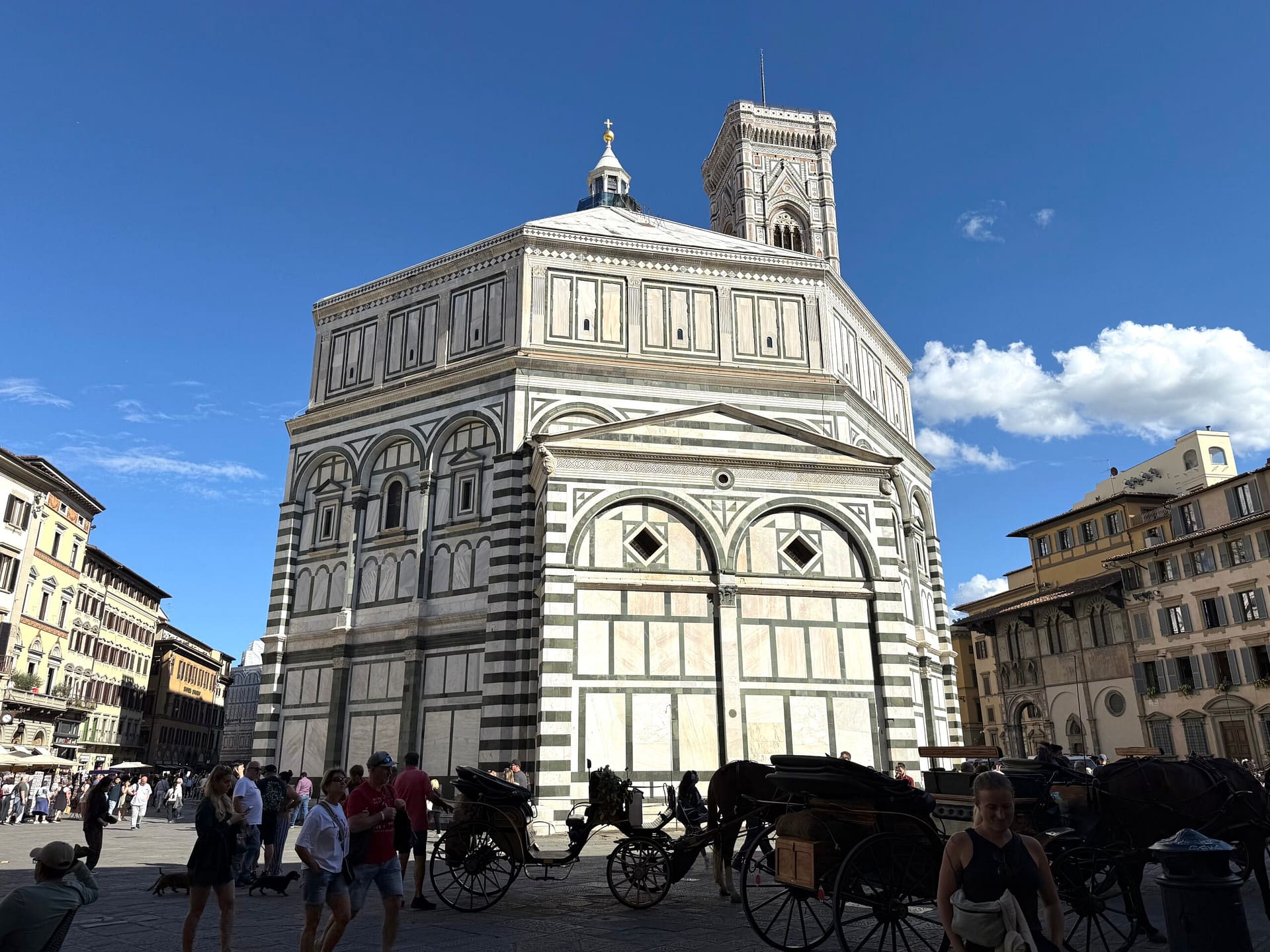
Battistero di San Giovanni
Battistero di San Giovanni
With a dazed awareness, my rational mind reminded me: I was indeed in Florence. I looked to the Baptistery of San Giovanni, the city’s spiritual compass. This octagonal structure, rooted in 4th-century foundations and reclad in its Florentine Romanesque skin during the 11th century, is a masterclass in geometric symbolism, a testament to rebirth and eternity. Its exterior is a rhythmic composition of white and green marble. Standing before the ten panels of the bronze Gates of Paradise that occupied twenty-seven years of Lorenzo Ghiberti’s career, I saw more than biblical narrative, perceiving instead the endurance of human devotion that earned Michelangelo’s admiration. It remains a monument to the Florentine commitment to proportion as a bridge to the divine.
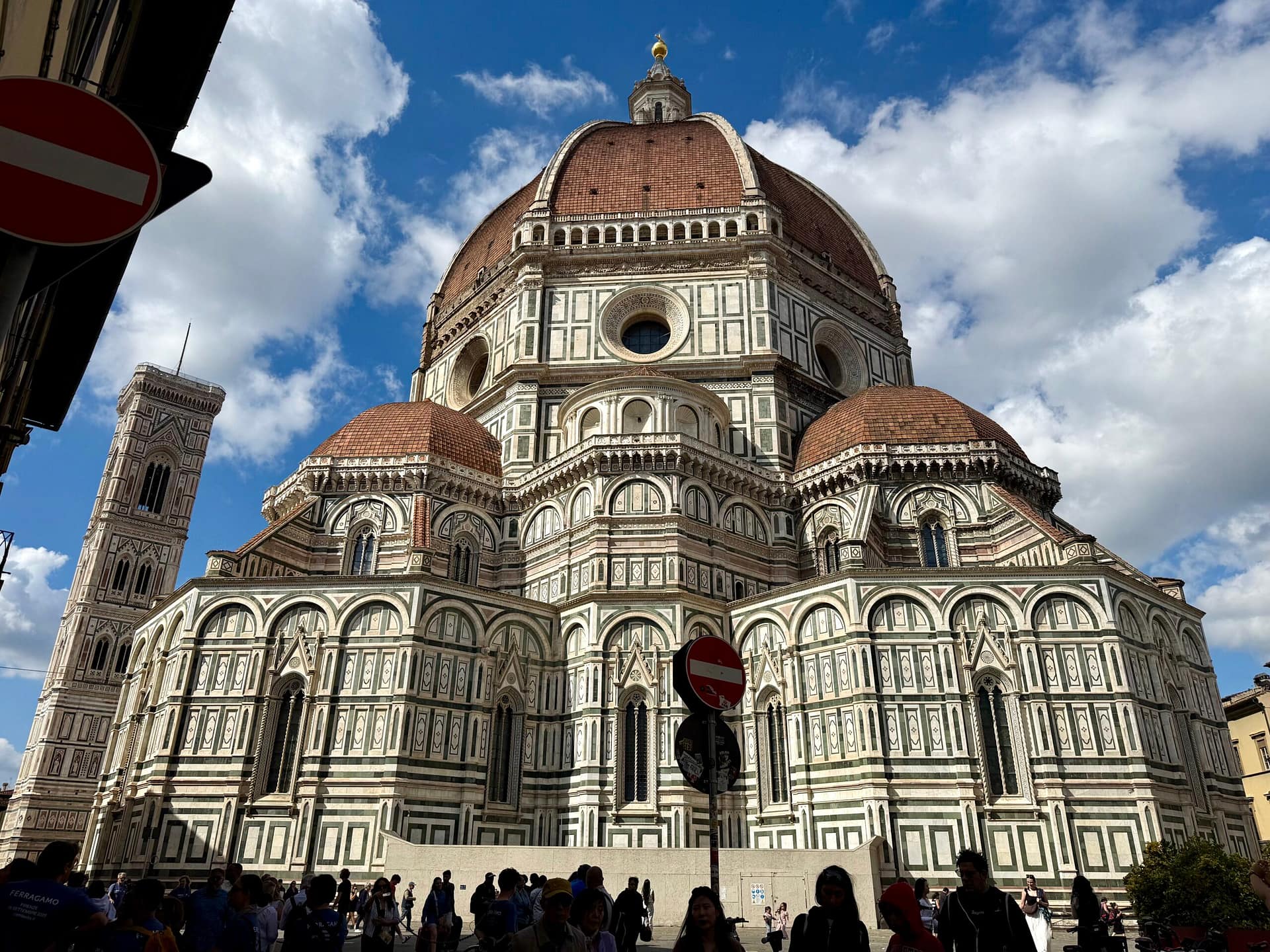
Cattedrale di Santa Maria del Fiore
Rising above the city’s skyline is Brunelleschi’s Dome, the legendary cupola, or “the egg.” Its double-shell structure, held together by the ingenious logic of herringbone brickwork, represents a definitive moment where architecture transcended mere craft to become an act of intellectual resolve. Brunelleschi did not just build a roof; he engineered a new relationship between gravity and grace. Standing in its shadow, I wondered: in our contemporary world, how many architects still strive to move beyond the efficiency of skill to realize such humanist ideals? The Cathedral confirms that architecture is never merely functional; it is a vessel of aspiration.
Cattedrale di Santa Maria del Fiore
I smiled, questioning if this was still a dream, and realizing that the distinction hardly mattered. To stand before this masterpiece is to enter a dialogue with the architect himself. I spent an hour circling the exterior, walking, pausing, and resisting the urge to join the queues. For this encounter, the exterior alone offered a sufficient sensory richness. The interplay of white Carrara, green Prato, and red Siena marble is a study in restraint and order. Together with Giotto’s Campanile, the ensemble forms a harmonious heart that beats with the early Renaissance.
Piazza della Signoria and Loggia dei Lanzi
Piazza della Signoria and Loggia dei Lanzi
Later, in the Piazza della Signoria, the city unfolds as an open-air gallery. Before the rugged stone of Palazzo Vecchio, the replica of Michelangelo’s David, whose original now finds sanctuary in the Galleria dell’Accademia, stands alongside Bandinelli’s Hercules and Cacus in silent, muscular tension. While David embodies the poised, internal resolve of the Republic, Bandinelli’s Hercules captures the dramatic struggle of myth. They are reminders that the Florentine square was never just a market, it was a theater of civic identity.
Beneath the arches of the Loggia dei Lanzi, the dialogue continues. Two works, in particular, arrested my attention: Giambologna’s Rape of the Sabine Women, a serpentine spiral of motion that renders violence with haunting beauty, and Cellini’s Perseus with the Head of Medusa, holding the severed head aloft as a frozen victory of reason over chaos. Nearby, Ammannati’s Fountain of Neptune rises; its central marble figure and the surrounding bronzes shimmer with the dominion of the sea, serving as a testament to Florence’s reach beyond the Tuscan hills. Walking here, I felt suspended between history, myth, and the profound capacity of human creativity. From this space, the path naturally flows toward the Uffizi Gallery.
Giambologna’s Rape of the Sabine Women
Cellini’s Perseus with the Head of Medusa
Replica of Michelangelo’s David
Ammannati’s Fountain of Neptune
Galleria degli Uffizi
I reserved a separate day for the Galleria degli Uffizi, ensuring enough time to immerse myself in the works. Designed by Giorgio Vasari to house the administrative offices (uffizi) of the Medici, the building now embodies the legacy of their patronage. Moving through the corridors, the rhythm of ancient sculptures is punctuated by ceilings adorned with refined, grotesque motifs, a sophisticated bridge between the galleries. Among its highlights are Botticelli’s The Birth of Venus and Primavera, along with major rooms devoted to Giotto, Leonardo da Vinci, Michelangelo, Raphael, Caravaggio, and Titian, allowing visitors to see the central figures of Italian art in a fluid historical progression. As my journey through the galleries neared its end, I found myself most deeply drawn to Titian. His depictions of Venus radiate a sensual vitality, his mastery of color and flesh allows emotion to breathe beyond the confines of the canvas.
At the top-floor café, I looked out over the rooftops. The dome, the campanile, and the tower of Palazzo Vecchio aligned on the same horizon, a breathtaking perspective. In that moment, the dialogue between art, architecture, and my own lived experience felt complete. The city was no longer a subject of study; it had become a space of being.
Courtyard of the Uffizi
Corridor ceiling adorned with grotesques
Titian, Venus of Urbino, 1538
Room 41: The Raphael Room
Museo Nazionale del Bargello
Entering the Museo Nazionale del Bargello feels like stepping into a narrative of transformation. Once a medieval headquarters and later a prison, it now stands as a premier example of adaptive reuse, a fortress-like sanctuary for Renaissance sculpture that feels worlds apart from the Uffizi’s grand halls.
Moving through the courtyard, the stone-crested walls and the central octagonal well anchor the space. On the ground floor, the collection highlights begin with Michelangelo’s works, such as Bacchus; yet ascending, the atmosphere shifts toward the mastery of Donatello. His bronze David is more lithe and delicate, carrying an androgynous quality that stands in provocative contrast to the muscular masculinity of the marble giant.
Beyond stone and bronze, the museum celebrates the Florentine civic spirit through its decorative arts. The most captivating discovery was the maiolica collection, where deep cobalt glazes and delicate portraits offer a warmth that balances the cold authority of the statues. Complementing these masters are Della Robbia’s glazed terracottas—vibrant pieces that bridged the gap between high art and the domestic sphere of the Florentine community. This “aura” brings life into the museum, weaving itself into the lived texture of the city that breathes through its craft.
Octagonal well in the courtyard
Reliefs and crests under the arcade
Donatello’s David
Deep cobalt maiolica collection
Casa Buonarroti & Basilica di Santa Croce di Firenze
On the recommendation of a local sculptor friend, I visited Casa Buonarroti. More than a home, this palazzo was reimagined by Michelangelo’s descendants into a temple honoring his genius. Inside, I found the collection of Sistine Chapel and his earliest masterpieces, the Madonna of the Stairs and the Battle of the Centaurs, carved when he was just a teenager. During my visit, I was impressed by the sight of students sitting before these works, sketching in a silent dialogue with the master.
What intrigued me most was how the family curated the myth of the “prodigy.” I saw sculptures depicting a young Michelangelo, tools in hand, carving the stone, a tribute to a greatness present from the very beginning. As I prepared to leave, rain began to fall. I sat in the courtyard, thinking of the distance I had traveled to be here, reflecting on the artistic legacy of Michelangelo. This great man now rests in the nearby Basilica di Santa Croce. Though I didn’t enter this time, I felt the weight of his immortality knowing his tomb, designed by his friend Vasari, lies just steps away.
Curated collection of Sistine Chapel
Sculpture of young Michelangelo
Courtyard of Casa Buonarroti
Basilica di Santa Croce di Firenze
The Bridges of the Arno
The Arno River is the lifeblood of Florence. The Ponte Vecchio, spanning the river since the 14th century, is the city’s oldest surviving bridge. It was transformed during the Medici era from a row of butcher shops into a center for goldsmiths. More than a path for commerce, it served as a symbolic passage, linking the civic heart of the city to the Oltrarno district and leading directly toward the Palazzo Pitti. It was the vital artery between the city’s political center and the family’s grand retreat.
However, the magic of the Arno reveals itself fully when one looks beyond the history. Standing upon the Ponte Vecchio, I found the views toward Ponte Santa Trinita and Ponte Amerigo Vespucci to be breathtaking. As evening fell, the streetlights lining the riverbanks and the projections upon the bridges spilled across the water’s surface, painting the Arno in a dance of golden light. In contrast to these grand evening scenes, I discovered a different kind of beauty one morning at Ponte alla Vittoria. Unadorned in its appearance, the bridge offered a glimpse into the authentic face of local Florentine life, a peaceful moment of stillness far from the tourist crowds.
Ponte alla Vittoria
Ponte Santa Trinita
Ponte Vecchio
Ponte Amerigo Vespucci
Palazzo Pitti & Giardino di Boboli
I wonder if the universe had its own designs; my final day in Florence was meant to be a departure, but a strike turned it into a journey of discovery. I decided then to surrender to the city for one last day, spending it entirely within the Giardino di Boboli. Though the Palazzo Pitti remained closed, the garden itself left me completely satisfied—a day of wandering through the quintessential of the Italian Renaissance garden.
From the slope rising behind the Anfiteatro, the landscape unfolds in a Renaissance perspective, sweeping past the Egyptian Obelisco toward the Fontana del Carciofo in a grand, symmetrical embrace. This monumental scale soon yields to the intimate garden of the Fontana delle Scimmie, where the city walls fade away into a breathtaking panorama of the rolling Tuscan hills. Wandering deeper, the Viottolone stretches endlessly toward the Fontana dell’Oceano, its cypress-lined avenue offering a rhythmic play of light and shadow that invites a slower, more meditative pace. Finally, the vast grassy incline softens at the Prato di Pegaso; here, as people recline on the grass with Brunelleschi’s dome resting on the horizon, the weight of history feels light. This is a place where time dissolved into conversation and the warmth of the afternoon sun. It was a day that belonged to no one but myself, a lingering farewell to Florence that felt more like a beginning than an end.
Slope rising behind Anfiteatro
Garden at Fontana delle Scimmie
Cypress-lined Viottolone
Grassy incline at Prato di Pegaso
Forte di Belvedere
Adjacent to the Giardino di Boboli, this mysterious vantage point high above the city was, without a doubt, my greatest surprise in Florence. I arrived here with no plans and very little preparation. Only the night before, I was still in Seravezza, fully inhabiting in the slow pace of local life. But a glance at the weather forecast promised a perfect sunny day in Florence—an intuition told me I couldn’t let it pass.
Following a local friend’s advice, I headed toward the city, intending to catch the sunset at Piazzale Michelangelo. Yet, as I walked from Ponte Vecchio, my feet seemed to have a mind of their own, leading me upward until I found myself here. With only thirty minutes left before the Giardino di Boboli closed, I stood at the gates, hesitant. Then, a miracle happened: someone handed me a free admission ticket to the Forte di Belvedere.
As I stepped onto the terrace, the entire panorama of Florence unveiled itself. The Duomo stood right before my eyes, so clear and majestic that it took my breath away in an instant. It was a moment of pure, unadulterated wonder. I watched as the sky deepened into a vibrant orange-red, the city transitioning from the clarity of day to the amber glow of twilight. Seeing the streetlights flicker on one by one was more moving than any image I had ever seen in a book or on a screen. It was a gentle reminder that lived experience imprints the heart in ways that imagination never could.
Lawn seating area
Seat with ancient frescoes
An expansive cityscape
Gathering on the hilltop
That evening, the hilltop was filled with music. Che! Tango Project was performing, their ensemble of guitar, violin, accordion, and percussion weaving a tapestry of sound through the air. Seeing a couple dance tango alongside, reminiscent of a scene from Scent of a Woman, was almost too romantic for my old soul to bear. Even the people I met were incredibly kind; strangers offered their seats, and on the walk back down, I shared a peaceful stroll and conversation with a mother and son from Australia.
This was my first night in Florence, and it remains the most beautiful memory I hold of this city. I later realized that this secret corner of the city opens its gates only during the summer times, as if it was a fleeting, seasonal gift. I hope, one day, I can return here with my beloved friends. Until then, I remain deeply grateful to this city for such a breathtaking welcome.
Sunset concert with a Florentine panoramic view at Forte di Belvedere
Palazzo Medici Riccardi
Returning from San Gimignano with a bit of time to spare, I visited the Palazzo Medici Riccardi. As the original residence of the Medici family, it stands as the definitive prototype of Renaissance domestic architecture. Upon entering, I was met by the classical courtyard. Here, Michelozzo, a disciple of Brunelleschi, employed a harmonious sequence of arches and columns. The rhythmic use of Pietra Serena, the signature blue-gray sandstone of Renaissance Florence, acts as architectural shadow, articulating the geometry and defining the spatial logic of the Quattrocento.
Walking through its halls, I reflected on the privilege of our era: the ability to freely appreciate these noble spaces once guarded for the elite. It is a gift of our time to stand where history was once hidden away. Gazing at the walls draped in frescoes, most notably Benozzo Gozzoli’s Procession of the Magi and the Galleria di Luca Giordano with its Baroque opulence added later by the Riccardi family, I wondered if the residents ever felt overwhelmed by such a density of visual information.
Michelozzo’s courtyard
Benozzo Gozzoli’s Procession of the Magi
Galleria di Luca Giordano
Gae Aulenti exhibition 2025
I was fortunate to catch the exhibition Modernity Can Build Otherwise: Gae Aulenti and Tuscany in the Fabiani Halls on the ground floor. The exhibition showcased the Italian architect Gae Aulenti and her diverse body of work, highlighting her philosophy that modernity can build through a respectful yet transformative dialogue between contemporary design and historic landscapes. Seeing her clean, modern architectural language set within the ancient stone walls of the palace was a refreshing contrast, a conversation between the weight of the past and the clarity of the present.
Unfinished façade of Basilica di San Lorenzo
Basilica di San Lorenzo
Just steps away from the Medici palace stands the family’s parish church, the burial site of its most influential members. While the interior is celebrated as a masterpiece of Brunelleschi’s rational perspective, housing the Old Sacristy, the Medici Chapels, and the Laurentian Library. Yet, with the limited time I had, I chose instead to observe its famous “unfinished” exterior. The façade remains a rough, bare layer of exposed stone masonry, a sight that often surprises visitors expecting grand Florentine marble. Michelangelo once spent years designing a white Carrara marble facade for the church, but the project was ultimately canceled due to costs and logistical challenges, leaving the structure in a state of perpetual, raw honesty.
Palazzo Strozzi as an art venue
Palazzo Strozzi
Situated in Florence’s most prestigious district, Palazzo Strozzi stands as a monumental manifesto, built to rival the Medici’s architectural dominance. Its massive, rusticated stone walls proclaim the ambition of a family that once dared to challenge the established order. Today, the Strozzi’s legacy transcends its imposing façade, serving as a dynamic bridge between the Renaissance and the present, hosting world-class contemporary art exhibitions. I had originally intended to visit the 2025 Fra Angelico, yet recognizing that his work demands more than a fleeting glance, I left with a promise to return. After all, Florence is not a city for rushing, but for returning.
Birthplace of Dante Alighieri
Museo Casa di Dante
Navigating the narrow alleys, I passed by Museo Casa di Dante, the house of the legendary poet Dante Alighieri, author of the Divine Comedy. Seeing the crowds overflowing from his birthplace, a site that still evokes the atmosphere of the Duecento, I chose to offer a respectful nod from the outside, preferring a silent greeting to his spirit over fighting the crowds. It was a quiet acknowledgment of the man whose face still accompanies every Italian through the 2-euro coin, a constant reminder of the poet who shaped the very language of this land.
Façade of Santa Maria Novella by Alberti
Basilica di Santa Maria Novella
Near the train station stands the Basilica di Santa Maria Novella. While its interior houses Masaccio’s revolutionary perspective, its exterior showcases Alberti’s geometric perfection, a marble façade that stands as the first great manifesto of Renaissance architectural theory. Yet, I spent my time outside, caught in conversation with a friend, letting the landmark serve as the backdrop to a shared moment. We sat facing the Loggia di San Paolo, its graceful arches echoing the design of Brunelleschi’s Ospedale degli Innocenti. I noticed the charming blue terracotta tondos by Andrea della Robbia that adorn the spandrels, their vibrant hues adding a touch of playfulness to the stone.
Museo di San Marco
The 2025 Fra Angelico exhibition spans Palazzo Strozzi and Museo di San Marco, where his frescoes bridge Gothic mysticism and Renaissance humanism. Beyond mastering Brunelleschian perspective, Angelico revolutionized the use of naturalistic light to convey divine presence, transforming monastic cells into ethereal spaces of contemplation. For Angelico, San Marco was never merely a gallery, but his home and sanctuary, a place where his identity as a friar and his genius as a painter became one, etched into the very walls where he lived and prayed. However, with the museum situated further from the center, I found myself short on time to make the journey, leaving his most intimate works for a future encounter.
Galleria dell’Accademia di Firenze
Not far from San Marco, the Galleria dell’Accademia houses the original marble of Michelangelo’s David. Yet, its presence still haunts the city through two notable replicas: the full-sized copy at the Palazzo Vecchio entrance and the bronze version at Piazzale Michelangelo.
La Tenda Rossa
Through a recommendation from the owner of D’ORIA in Forte dei Marmi, I found my way to La Tenda Rossa for the final dinner of my stay in Florence. Located just steps from the Piazza della Signoria, the restaurant offered an exceptional Fine Dining experience with a warm, inviting atmosphere. The owner greeted me with genuine hospitality, and it was the perfect choice for my last night, a memorable farewell to the city where friendship and flavor intertwined.
A touch of elegance at the entrance
Authentic beef and roasted vegetables
Atmosphere of timeless charm
Seat framed by the city
Birreria Centrale
Guided by a local friend, I stepped into Birreria Centrale, a historic gem nestled away in the Piazza dei Cimatori near Dante’s House. Inside, the vintage wood paneling and warm brass whispered stories of a century past. We shared the classic Florentine steak, a perfectly seared testament to Tuscan tradition, and I realized that some of Florence’s best masterpieces aren’t found in museums, but on a well-worn dinner table among friends.
A vintage welcome at the entrance
T-bone steak Florentine style
Interior with a historic character
Seat bathed in natural light
Aqa Palace
Quietly integrated into a local residential neighborhood in the Santa Croce district, this sophisticated retreat offers the refined elegance of privacy and modern design. Known as Aqa Palace, its suites are clean and spacious, beautifully blending the historic bones of the building with curated interiors. On this journey, I happened to stay in the rooftop suite; standing on the private terrace, I could see the Arnolfo Tower of Palazzo Vecchio and hear the rhythmic tolling of bells before I retired for the night. It was the perfect place to decompress in style after a day immersed in the city’s Renaissance masterpieces.
Adorned residential entrance
Space curated with artistic flair
Spacious room in the apartment
Private terrace of junior suite
Hotel Machiavelli Palace
Ideally positioned just a few minutes’ walk from the Santa Maria Novella station, this historic residence offers the ultimate convenience for any traveler. The interior is defined by its well-maintained rooms, providing a clean space amidst the historic center. Beyond the comfort, the rooftop terrace offers a view face-to-face with the dome of San Lorenzo. Known as Hotel Machiavelli Palace, it is a place where effortless accessibility meets one of the most iconic views in Florence.