Before setting foot in Italy, a friend insisted that Verona requires at least two days to inhabit its atmosphere. Journeying from Florence to Venice and finally arriving here, I sensed a shift in the flow of time. Perhaps shaped by its proximity to Milan, Verona carries a refined, contemporary pulse. It is a city where the high-end boutiques intertwines with the grace of the Middle Ages. There is a dignified warmth here, making it not merely a place for leisure, but an ordinary scene of curated beauty.
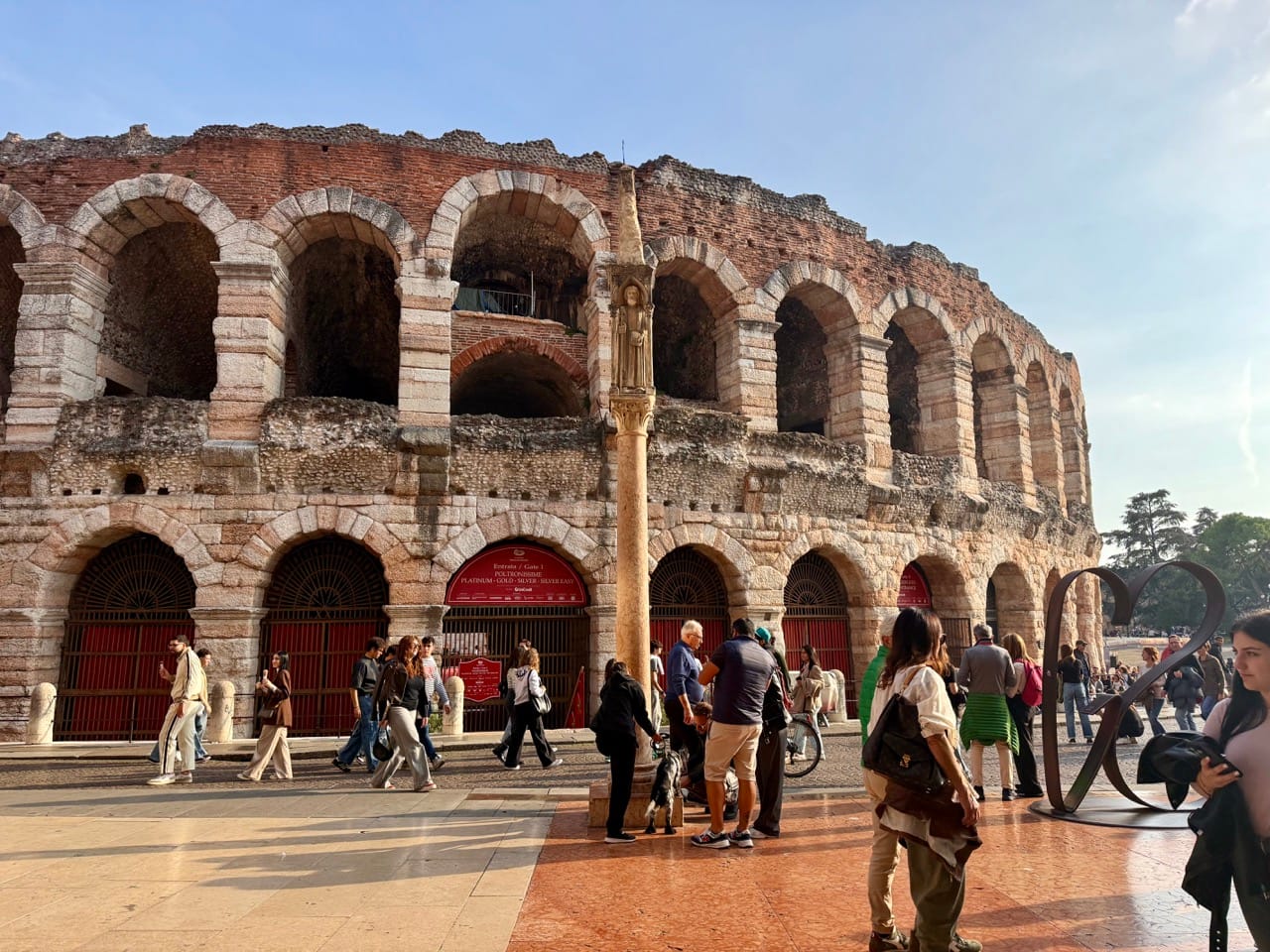
The liston beside the Arena di Verona
Piazza Bra & Arena di Verona
At the threshold of the historic zone, Piazza Bra unfolds toward the city’s most enduring monument: the Arena di Verona. Completed in the 1st century CE, it is the third-largest Roman amphitheater and predates the Colosseum, standing among the most remarkably preserved of its kind. Built from local Veronese limestone, its weathered tiers exemplify Roman mastery of proportion, material, and engineering. Even today, the Arena continues to fulfill its original civic role, hosting world-class operas beneath a starlit Veronese sky, a ritual that reactivates the ancient dialogue between monumental architecture, public life, and collective memory.
The City of Marble
Verona is often whispered to be the city of marble, a title carved directly from its own landscape. Quarried from the Lessini Mountains and the Valpolicella region to the north, this stone originates in ancient seabeds where Jurassic-era ammonites once settled, forming what would become the city’s pink-hued soul. Yet unlike the celestial, cold purity of Carrara, Verona’s stone carries a visceral, almost domestic warmth. Known as Rosso Verona, it ranges in tone from pale pink and warm orange to deep, earthen red.
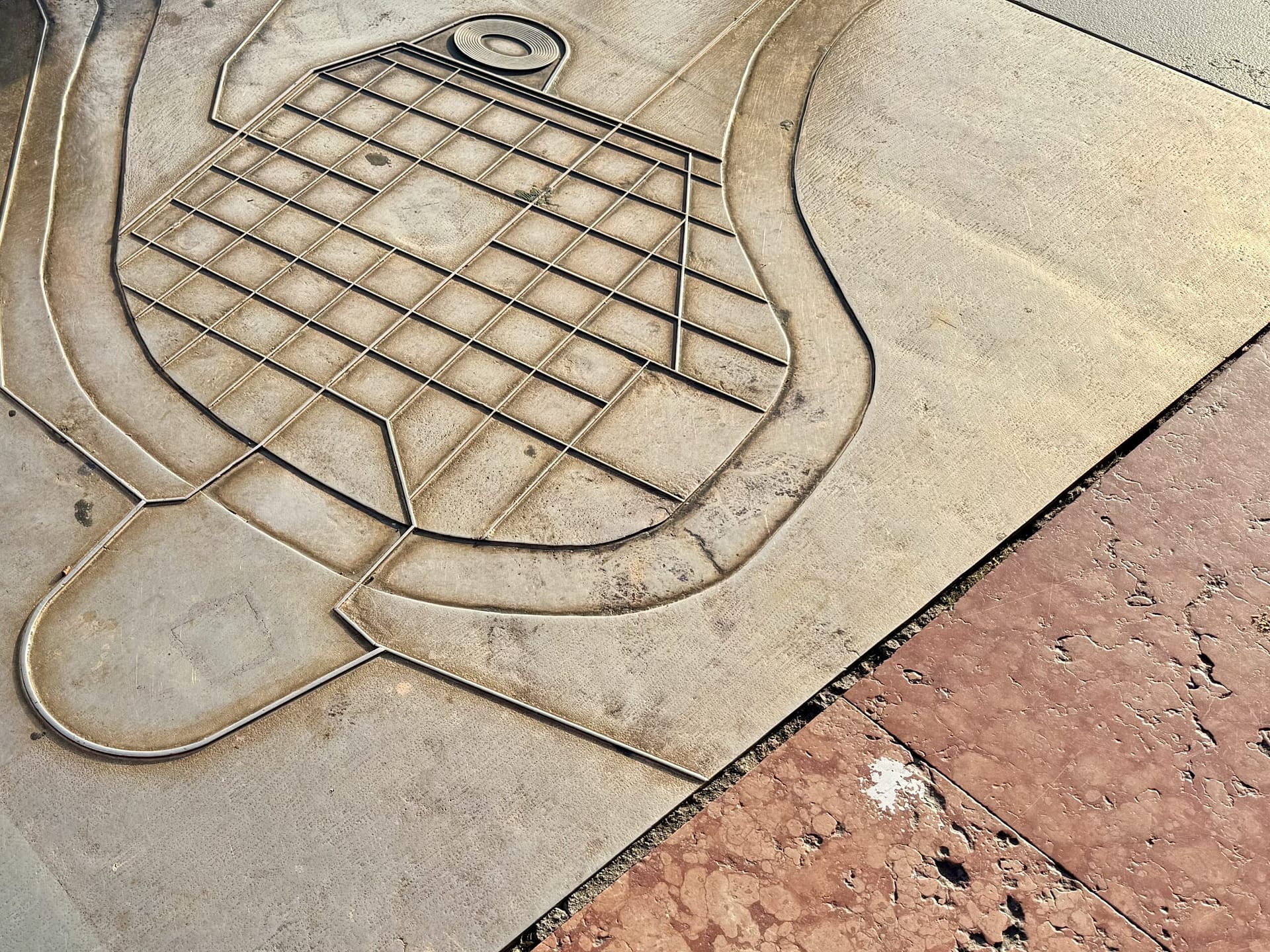
Moving from the Arena toward the historic center, the first encounter is the Liston, a broad, roseate marble promenade, polished by centuries of footsteps to a mirror-like sheen. Along Via Mazzini, Verona’s renowned fashion street, marble extends across the urban fabric; even pedestrian crossings are paved in stone. If walking attentively, the pavement occasionally reveals the silhouettes of fossils formed hundreds of millions of years ago. It is this encounter that makes Verona feel like the world’s most luxurious open-air natural history museum.
Bronze map set into marble pavement
Rosso Verona marble steps
Marble-paved Via Mazzini
Marble-paved pedestrian crossings
Casa di Giulietta & Piazza delle Erbe & Piazza dei Signori
Beyond Verona’s literary imagination—the balcony of Juliet that draws romantic pilgrims—lies the city’s spirit: its squares. Piazza delle Erbe, once a Roman forum, unfolds as a vibrant tapestry of frescoed façades and market umbrellas, while civic towers form a palimpsest of Roman, medieval, and Renaissance urban life. The horizontal stripes of the Cortile del Mercato Vecchio add a subtle geometric rhythm to the ensemble. Just a few steps away, the atmosphere softens at Piazza dei Signori, Verona’s drawing room, framed by the sober, aristocratic palaces of the Scaligeri dynasty and overseen by the statue of Dante Alighieri. As I wandered through these squares, the street lamps came alive and the warm glow illuminated the pink stones, musicians performing from balconies echoed Juliet’s legendary culture.
Casa di Giulietta
Piazza delle Erbe
Piazza dei Signori
Cortile del Mercato Vecchio
Museo di Castelvecchio
The Castelvecchio, literally the Old Castle, takes its name from a strategic shift in the city’s defenses, becoming “old” when the focus of power moved to the “new” castle on the hill. Originally the fortified seat of the Scaligeri dynasty, it now houses a priceless collection of Veronese sculpture, jewelry, and paintings from the Romanesque to the 18th century, yet it remains inseparable from Carlo Scarpa’s radical intervention. In the late 1950s, director Licisco Magagnato sought to modernize the displays from static chronology to a dynamic experience. Scarpa’s mid-20th-century renovation deconstructs centuries of historical layers to create a poetic dialogue between medieval fortress and modern sensibilities. Through meticulous detailing, he introduced subtle “splits” and “gaps” between original walls and new interventions, allowing the building’s history to breathe rather than merely imitate the past.
The castle’s rugged silhouette is defined by its Ghibelline (Swallowtail) merlons. These iconic M-shaped battlements are far more than decorative flourishes; they are a visual manifesto of 14th-century political theology, articulating the Scaligeri’s historical allegiance to the Holy Roman Emperor against the Papacy.
Main entrance of the Castelvecchioe
Medieval windows, Gothic elegance
Ground-floor sculpture gallery
Scarpa’s architectural intervention
Ponte di Castelvecchio
This fortified bridge serves as a monumental extension of the castle’s defensive logic, its silhouette traced by a continuous procession of Ghibelline merlons. As I arrived, the sun began its descent, casting sharp shadows onto the red brick walls. Beyond its military origins, the bridge has become a vibrant gathering place, where locals and visitors pause to rest and admire the view. Its soaring brick arch forms a majestic span across the Adige River, offering me of the city’s most evocative medieval vistas.
Soaring arch spans the Adige River
M-shaped battlements
Seatings along the bridge
Wide, symmetrical central walkway
Ponte Pietra & Castel San Pietro
I wandered along the riverbank, immersing myself in local life. Further upstream stands Ponte Pietra, Verona’s oldest bridge, originally Roman and repeatedly reconstructed after floods and wars. Its stonework displays an evolution of texture and color along its arches, reflecting both ancient foundations and later interventions. Alongside the bridge, a landscaped riverside promenade guides pedestrians with gentle curves and carefully proportioned paving, offering pauses to admire the water and cityscape. Crossing the bridge leads toward Castel San Pietro, perched above the city; I did not climb to the castle this time, but even from the riverbank, Verona reveals itself as a harmonious composition of river bends, stone roofs, and distant hills, particularly breathtaking at the golden hour, accompanied by the city’s tolling bells that evoke a sense of medieval romance.
Landscaped riverbank promenade
Romantic Romanesque vistas
Reflection on the water forms a circle
Castel perched on the hillside
Giusti Garden
A seminal example of Italian Renaissance landscape design, the Giusti Garden was praised by Goethe for its serene grandeur, one of the must-visit sites I marked on my map. The lower parterre features formal geometry and a classic boxwood labyrinth, while the upper terraces unfold into a wilder, Mannerist mystery. The entrance is anchored by Ghibelline merlons, linking the garden to Verona’s noble past. Famous cypress-lined avenues guide the eye along symmetrical walkways, drawing attention upward to a monumental stone mask, the Mascherone, at the summit, symbolizing a spiritual ascent from the rational order of the parterre to the poetic heights of the panoramic terraces overlooking the city of Verona.
Pyramidal obelisks echo upward trees
Borrowed scenery frames Verona
Symmetrical Renaissance garden
Pavilion with 13th-century columns
Hotel Accademia
Located within walking distance of Verona’s premier fashion district, Hotel Accademia occupies a historic building that quietly preserves the city’s architectural character. Mornings begin with a generous breakfast, attentive to both local tradition and comfort. At night, within the elegant interior, the view from the window offered an unexpected gift: Verona’s stone surfaces softly illuminated beneath a full moon. It is an intimate and unforgettable closing scene, a moment of pure serenity.