Located in the heart of Tuscany, Siena is a medieval jewel that once stood as a formidable city-state, Florence’s eternal rival, challenging its neighbor in both banking and the arts. While Florence embodies the balanced rationalism of the Renaissance, Siena remains a soaring monument to the Gothic spirit. It is a city colored by Terra di Siena, defined by its distinctive burnt-sienna brickwork and an urban plan that clings to the natural ridges of the hills.
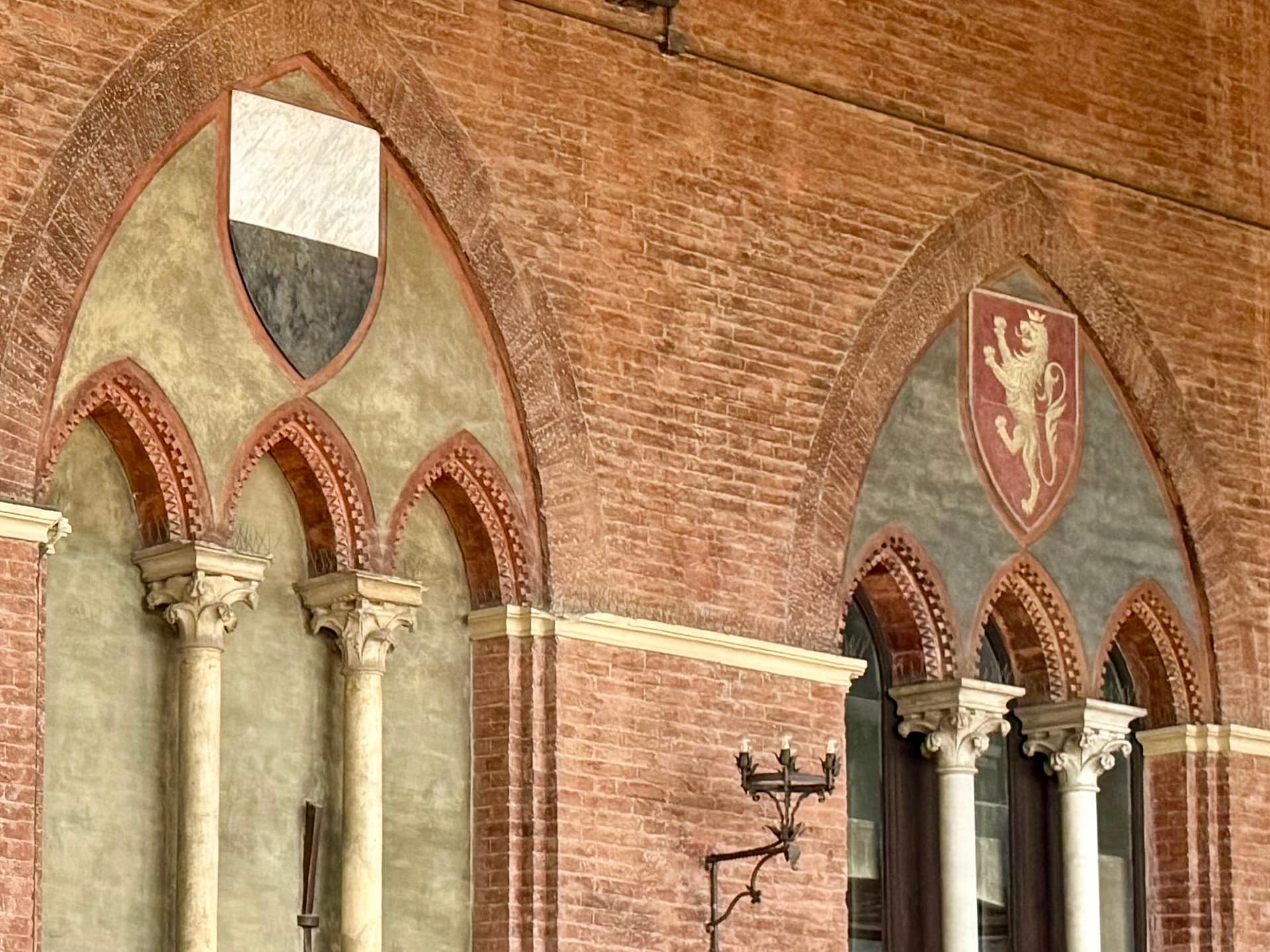
Coat of arms of the Sienese Commune
I was deeply impressed by the disarming intimacy of the city’s civic iconography; Siena is a master of branding, capturing the collective spirit through a visual language imbued with medieval charm. Everywhere, the city’s identity is broadcast through its emblems: the Balzana, the black-and-white coat of arms of the Sienese Commune; the Lion of the Capitano del Popolo; and the Lupa Senese, a reminder of its legendary Roman roots, claiming descent from the sons of Remus. These symbols form a cohesive narrative of a city that views itself as a chosen, sacred community, and they serve as the visual constitution of a self-governing republic.
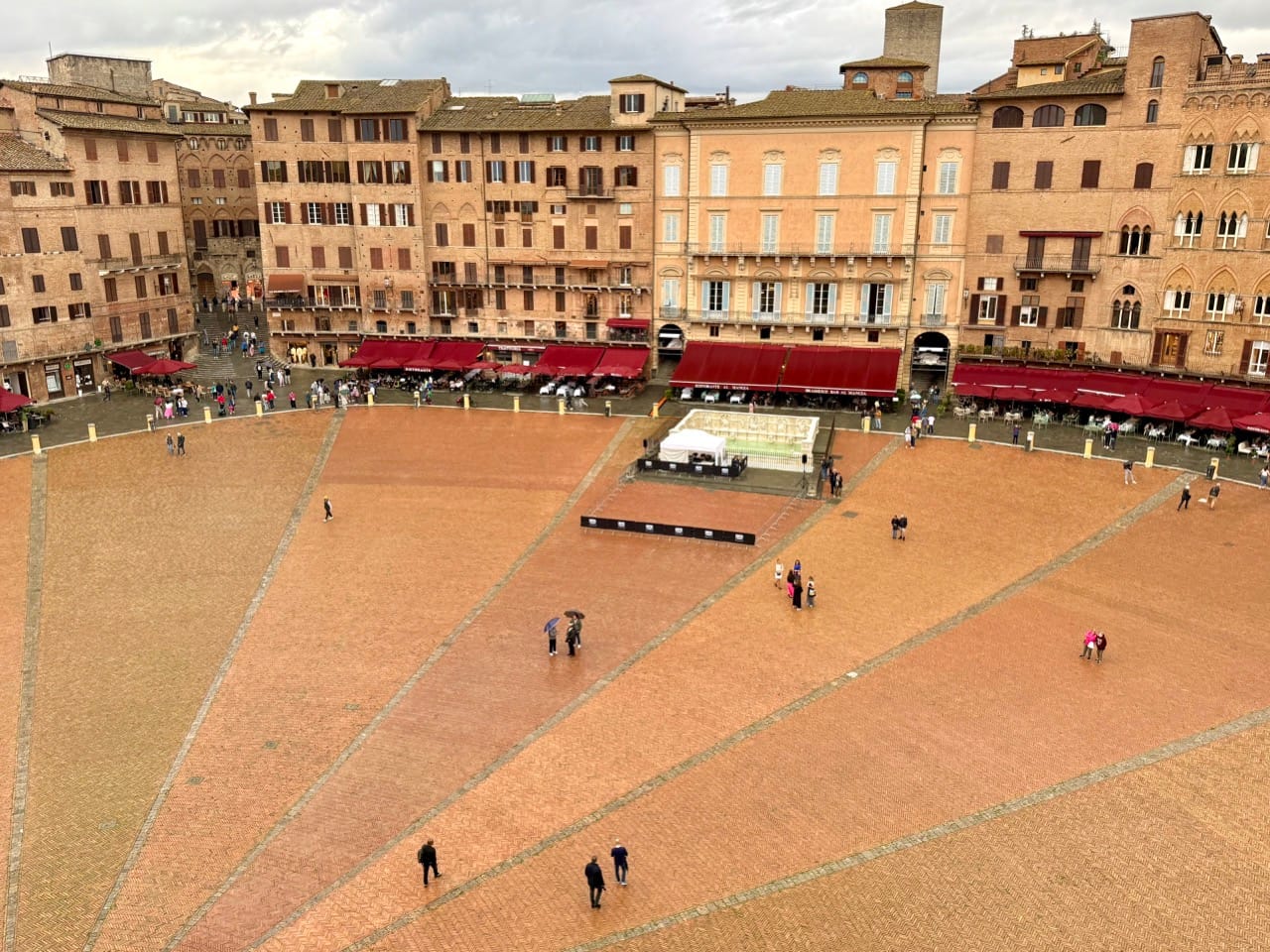
Piazza del Campo
Following the map I reached the Costarella dei Barbieri. The alleyway suddenly yields to the openness of Piazza del Campo, where the Palazzo Pubblico and the Torre del Mangia frame the far end of the view, command the horizon. I felt my long-held dream was finally realized, as deep as my first encounter with the Duomo in Florence. I paused at the alley, suspending that first glimpse to let the memories settle. This is the bastion of medieval glory, the sacred heart of its conviction.
The asymmetry square grew by following the natural contours of the land. More than a sight to behold, the slope of the shell-shaped Piazza must be felt through the soles of one’s feet. This incline is a masterwork of medieval engineering, designed to funnel both the gaze and the rainwater toward the civic heart. Divided into nine sectors, representing the Council of Nine, the brick pavement radiates from the central drain with a functional elegance. Twice a year, this brickwork is buried under earth for the Palio, the world’s most fervent ritual of speed.
Civic square divided into nine sections
Palazzo Pubblico
Upon the façade of the Palazzo Pubblico, I noted the Medici coat of arms, the heraldic scar of the 1555 conquest, and the circular IHS Christogram presiding over the Medici shield, a symbol widely promoted by Saint Bernardino of Siena, stands as a testament that above all secular governance, the ultimate authority remains divine.
As I ascended the tower, the rain began to fall, echoing the moment I experienced at the tower in Pisa, a gift that offered me a different perspective. From above, the empty square glistened, the moisture deepening the hues of the brick from a sun-bleached to a saturated burnt-sienna. The city assumed an ancient weight, more authentically 14th-century in its solitude.
View from Costarella dei Barbieri
IHS above the Medici coat of arms
Fortified courtyard of Palazzo Pubblico
Capitoline Wolf ties Siena to Rome
Entering the Palazzo Pubblico feels like stepping into a fortified dream. The central courtyard looks upward into a square of sky, framed by the rhythmic repetition of the city’s shields. I came here with great anticipation for Ambrogio Lorenzetti’s Allegory of Good and Bad Government. In an age of low literacy, these murals functioned as the “screens” of the citizens, vivid manifestos of civic governance. I was moved by the Good Government side, with its harmonious streetscapes and pastoral landscapes, a blueprint of an ideal world, yet balanced by the contrast reminder of our capacity for self-destruction. In the Sala del Mappamondo, Simone Martini’s Maestà glows with a quiet power, where the IHS sign reappears as a seal of protection over the city’s deliberations.
The Allegory of Good Government
Sala del Mappamondo
Sala del Concistoro
Depiction of Siena’s founding legend
The Sala del Concistoro offers a shift in atmosphere: a chamber of vibrant crimson. This heavy, solemn red emanates an air of ancient authority. Looking up, the Mannerist ceiling by Beccafumi dissolves into a kaleidoscopic vision, creating a sharp dialogue with the burnt-sienna walls and the elegant white marble portals. The materiality here reflects a profoundly direct Sienese taste.
Piazza del Duomo di Siena
Duomo di Siena
At the Duomo di Siena, the narrative unfolds differently. If Florence is about structural clarity, Siena is about ornamental intensity. Driven by competing with Florence, the Sienese pushed their decorative expression to its limit. Inside, the atmosphere is shadowy and transcendental, forests of Prato green and white Carrara marble columns create a rhythmic depth. The floor is an epic of narrative marble pavement. I marveled at the medieval capacity to “paint with stone,” specifically through the marble intarsia crafted from local stone, drawn particularly to the circular She-Wolf and her allied cities, a striking cartography of medieval loyalty. Above, the vaulting is a canopy of stars set in a lapis-lazuli sky, centered by a hexagonal dome and a gilded oculus lantern, acting as a beacon of divine light.
Amidst the Duomo’s black-and-white marble stripes, a small side door opens to the Libreria Piccolomini, a burst of color disrupting the cathedral’s contemplative gloom. Built to house Pope Pius II’s rich manuscripts, the room is a symphony of High Renaissance frescoes by Pinturicchio, anchored by the ancient Roman marble Three Graces at its center. Here, the scholarly and sacred converge, reflecting Siena’s pursuit of both intellectual legacy and visual transcendence.
After such a narrative feast, I felt a sense of information overload. The entire world was “on display” through stone and pigment; a collective faith etched into every surface by artists who poured their devotion into their craft. For the medieval mind, this singularity of belief provided a primal and piercing energy, a concentrated force of attention that our modern, fragmented existence cannot replicate. This earnestness is what profoundly stirs the innermost depths of my soul.
Black-and-white marble stripes
Hexagonal dome with starry coffers
High Renaissance frescoed chamber
Circular She-Wolf and her allied cities
Leaving the Duomo at the golden hour, the streetlamps flickered along the sloping alleys, and the city revealed itself as a sea of flags, the banners of the Contrade asserting their ancient identity. To my eyes, the notion of the “Dark Ages” has always felt like a misreading. On the contrary, it was an era full of vibrant and innocent vigor, a spirit often misunderstood due to the fragmentary nature of its records. The Sienese, unburdened by the rigid dictates of liner perspective or the clinical proportions, captured something more vital: the light of the spirit. Walking these sloping bricks, Lorenzetti’s mural returned to me as a living image: a city thriving in peace, with people dancing and singing in the streets, inhabiting a simple, profound joy in the present moment.