As I approached Pisa, I had imagined it as little more than a ubiquitous tourist spot, a place for snapshots with the Leaning Tower. Yet, upon first stepping into the square, the sublime ensemble of monumental white marble buildings immediately distilled my focus, drawing my attention away from the crowds. No photograph could capture the profound presence, scale, and luminosity of the architecture before me. I could truly believe that this is one of Italy’s most remarkable creations, and calling Piazza del Duomo a “Square of Miracles” feels entirely justified. Its Cathedral, Baptistery, Camposanto Monumentale, and, of course, the Leaning Tower exemplify Pisa’s mastery of medieval and Renaissance design.
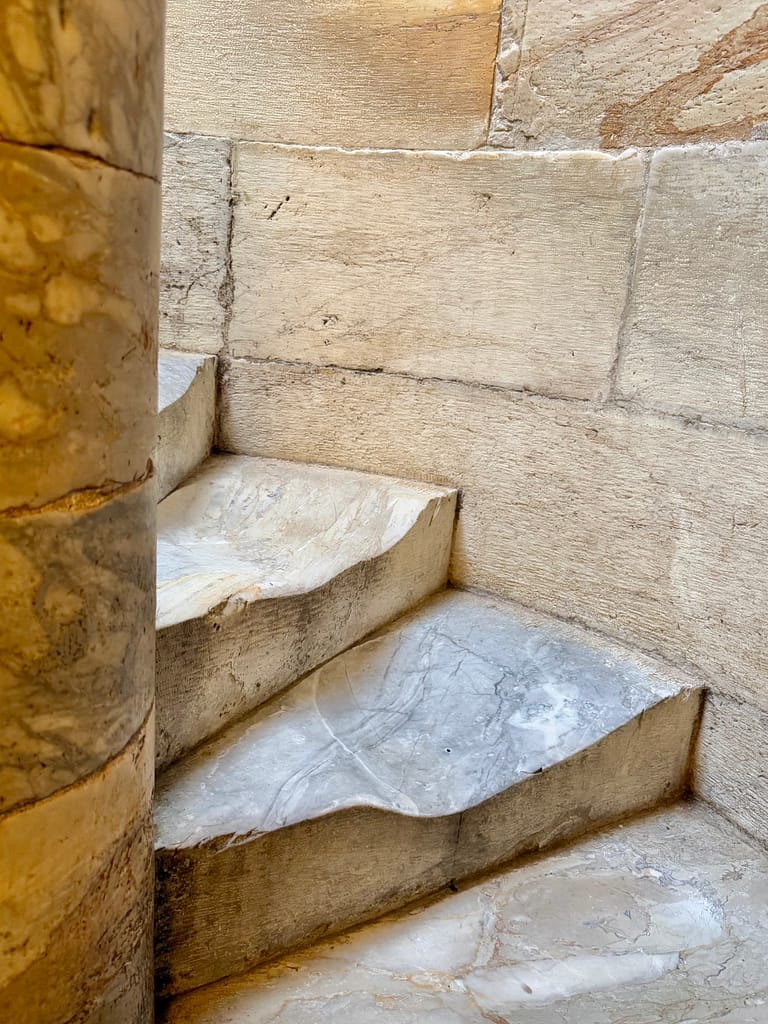
Centuries of footsteps worn into stones
Pisa lies in western Tuscany, near the Ligurian coast, a city whose maritime republic once dominated the Mediterranean. The Sinopie Museum, in particular, also one of the official ticket offices, offers a comprehensive glimpse into the city’s history; its layered, dynamically-sequenced spatial design and finely curated exhibits foster a contemplative experience well worth visiting.
When I ascended the stone steps of the Leaning Tower, rain began to fall, softening the white marble beneath my hands and feet. I circled the top, observing the people in the square, listening to the bells, and noting how the weathering accentuated the marble’s natural veins and the traces left by time and human activity. When the rain cleared, I walked through the Cathedral, Baptistery, and Camposanto, where the marble surfaces seemed to engage in a dialogue.
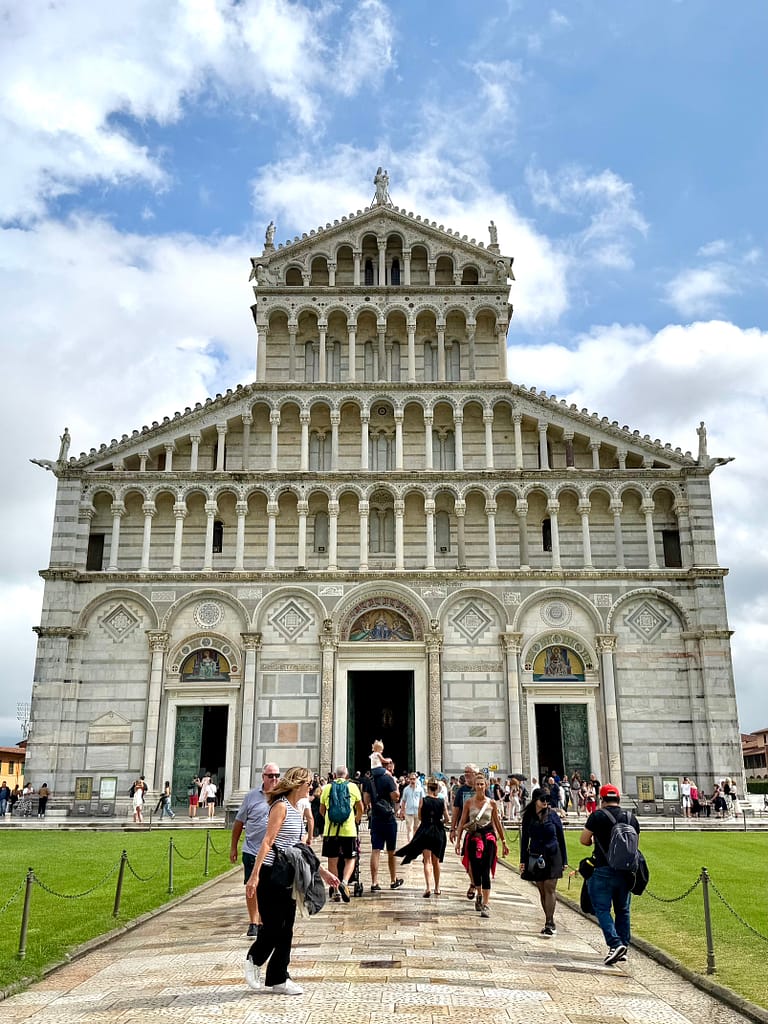
The Cathedral’s façade, a definitive archetype of Pisan–Lucchese Romanesque, with its thick walls, rounded arches, articulated arcades, repeating columns, and sculptural details, echoed similar façades in nearby Lucca, illustrating a shared regional vernacular. Inside, Byzantine-influenced mosaics on the apse reinforce the Cathedral’s historical and artistic significance. The Baptistery, renowned for its extraordinary acoustic resonance, transforms sound into a pure, lingering echo, demonstrating mastery of material, form, and sensory experience. Within the Camposanto, frescoes in terracotta hues and polished marble floors enfold the cloistered courtyard, narrating centuries of life and devotion. At that moment, I did not decipher every story on the walls; instead, I sat alone, absorbing the atmosphere, sensing the layers of history and artistry surrounding me. Half an hour passed before I continued my exploration, accompanied only by the presence of art and architecture.
The Cathedral’s façade
Byzantine mosaics on the apse
Baptistery is aligned with the Cathedral
Repeating columns of the Leaning Tower
Pisa is also a venerable university city, home to the Università di Pisa, renowned for its contributions to science and mathematics, whose students infuse vitality into the streets lined with ancient stone. I did not visit the academic quarters this time, preferring to savor a Spritz, an Italian ritual, and enjoy a slice of pizza in Pisa. While strolling back to the station, the city whispered of its maritime past, the weight of centuries settling with each step.