Astrology and Science in Dialogue Under a Blue Sky
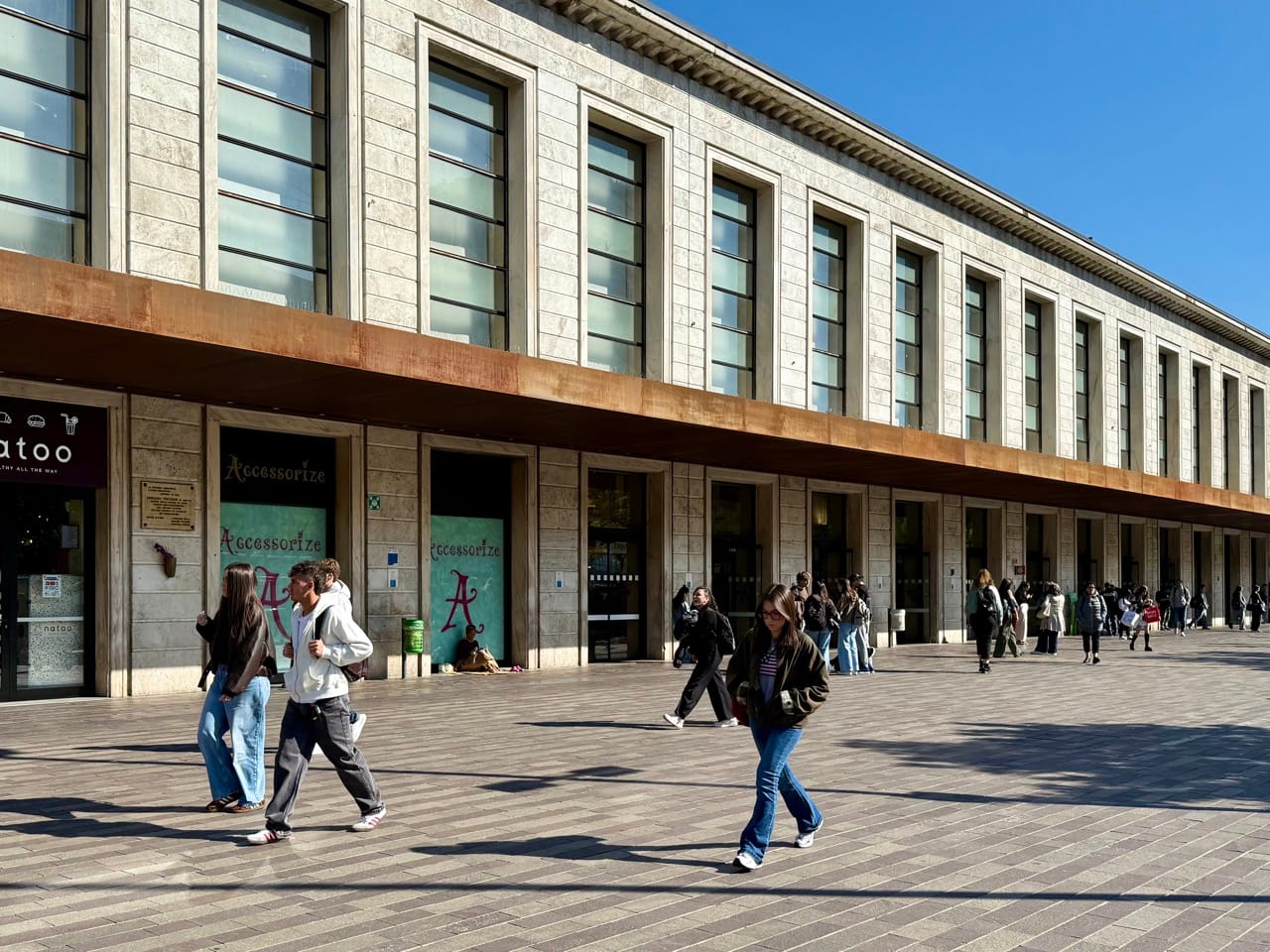
Square outside the railway station
Located in Veneto, a stone’s throw from Venice, Padova is a city I have long yearned to visit. It stands in a similar relation to Venice as Siena does to Florence, yet their bond was defined by strategic autonomy rather than rivalry. Under Venetian rule, Padova flourished as an intellectual stronghold where science, medicine, and anatomy were shielded from ecclesiastical interference. It functioned as the rational backstage of the Republic, the very stage where Galileo Galilei once challenged the stars.
Traveling north from Bologna, the urban palette shifted. Though both are university cities, Padova departs from Bologna’s warmth, presenting a cooler spectrum of restrained air. The aura of this “Little Venice” remains one of my favorite atmospheres in Italy. Even the railway station conveys a timeless yet modernist aesthetic, blending Renaissance and Neoclassical echoes into its rhythmic façade. Outside, the Piazza della Stazione offers a pedestrian comfort that articulates the city’s contemporary taste.
Cappella degli Scrovegni
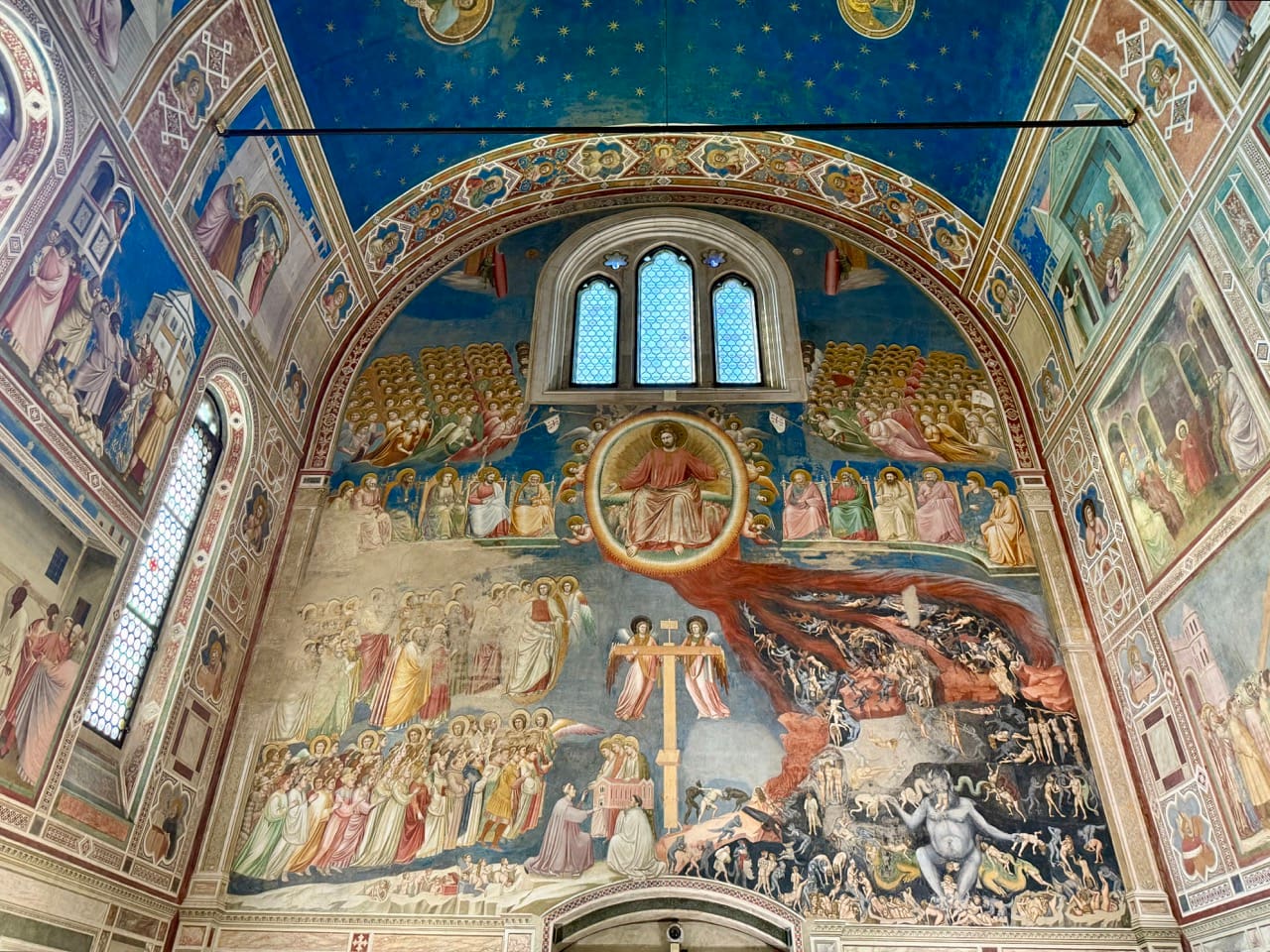
If one goes to Siena for the frescoes of the Palazzo Pubblico, one comes to Padua for Giotto at the Cappella degli Scrovegni. Though the visit is limited to fifteen minutes, a scientific necessity for preservation that I deeply respect, those minutes were transcendent.
Immersed beneath this medieval ultramarine blue sky, I felt a swell of emotion that was almost beyond words. This experience differs from standing before the Duomo in Florence: it is not an encounter defined by awe at monumental grandeur, but rather one of total enclosure, like being inside a celestial theater. Here, Giotto bridged the gap between the flat, mystical language of Byzantine art and the dawn of humanism, introducing weight, spatial depth, and profound human sorrow into painting. In our age of high-tech projections and immersive digital spectacles, this transformation may be difficult to imagine, yet it marked a turning point in human consciousness.
The Last Judgment on the west wall
Frescoed sacred narratives
Giotto’s painted marble on the dado level
Frescoes in harmony with red marble
Eremitani Museums
Just steps away from Giotto’s frescoes, the Eremitani Museums occupy a 14th-century Augustinian monastery. Wandering through its collection of Paleovenetian and Roman artifacts while waiting for my appointment at the Scrovegni Chapel, I found an unexpected clarity in its archeological honesty. In the neighboring church of the Eremitani, the pink-and-white tomb of Jacopo II da Carrara caught my eye. Sculpted by the Venetian master Andriolo de Santi, the monument is a striking composition of blushing Verona red marble and pristine white stone, serving as a testament to the Carrara family’s legacy. The way these structures—the museum, the church, and the tombs—interconnect yet maintain their distinct historical roles is a beautiful exercise in urban layering.
View toward Scrovegni Chapel
Sculptures displayed along loggias
Charming fragmentary
Tomb of Jacopo II da Carrara
Palazzo della Ragione
My journey continued to the Palazzo della Ragione. Driven by a fascination with astrology and the intricate order of the cosmos, this was more than a stop; it felt like a necessary pilgrimage. This vast civic building is framed by double-layered loggias. While the ground floor buzzes with market life, ascending the stairs to the second floor reveals an entirely different world. Beneath these arches, vaulted ceilings painted with fruits unfold; at the far end of my gaze, the pinkish expanse of Palazzo delle Debite emerges as a visual feast of color and harmony. Entering the great hall known as Il Salone, I felt a transition from Giotto’s celestial theater to the cosmos itself. It remains one of the largest medieval unsupported halls in Europe, a structural feat that still commands admiration.
Although Giotto’s original works were lost in a fire in 1420, the surviving frescoes, mapping the months, zodiac signs, and human affairs, represent a monumental medieval endeavor to synchronize human justice with the order of the stars. I wandered through this painted universe for nearly an hour before moving on.
Double-layered loggias
Great hall with astrological frescoes
Vaulted ceilings painted with fruits
Pink-hued Palazzo delle Debite
Torre dell'Orologio
The curiosity about the cosmos led me to the Torre dell’Orologio in Piazza dei Signori. More than a mere timepiece, it functions as the city’s astrolabe, a 14th-century masterpiece conceived by Jacopo Dondi, visualizing the intersection of time, knowledge, and power. Nestled above a triumphal arch, the clock tracks the sun, the phases of the moon, and the zodiac against a field of celestial blue, a rational blue that serves not as decoration, but as a precise cartography of the heavens. Here, time dances with the cosmos; today’s digital watches reduce it to mere numbers, stripping away that astral imagination. Nearby, the Lion of Saint Mark stands as a constant reminder of Venetian authority over this intellectual stronghold.
Elegant and rational in design
Astronomical clock atop triumphal arch
The Lion of Saint Mark
The clock situated in Piazza dei Signori
Piazza Duomo
At the Piazza Duomo, the evening light fell on parents lingering with their children, a scene that echoed the vibrant communal life I once witnessed in Pietrasanta. There is something moving about how Italian children are allowed to inhabit their monuments, climbing on historic stones with a natural ease. Watching them playing together before the cathedral, the world seemed to dissolve into a momentary, unadulterated joy, and a quiet, secular blessing.
Girl playing with birds
Children interacting with the cathedral
Children climbing the sculptures
Historical fragments revealed nearby
Duomo di Padova
Although the Padua Cathedral remains “unfinished” in its facade of raw, unadorned brick—lacking the marble grandeur shared with Bologna’s San Petronio and Florence’s San Lorenzo—yet the moment the doors open, I was greeted by a pure, sacred white. This is the true inner sanctuary.
The interior offers a rare Renaissance clarity: bright and spacious, defined by geometric symmetry reportedly inspired by Michelangelo, and crowned by the elegant curves of its dome. In the foreground, contemporary sculptures by Giuliano Vangi add a touch of minimalist warmth, their clean lines conveying refined human emotion and creating a subtle dialogue between the ancient and the modern. It stands as the spiritual core that lies behind the city’s scientific rigor and cosmic laws.
View from the entrance
Looking up at the dome
Details revealed in sunlight
Sculptures by Giuliano Vangi
Gio Ponti’s Staircase of Knowledge
Palazzo del Bo, Università degli Studi di Padova
On my way back to the station, I passed through the Palazzo del Bo, the heart of the university. The contrast between spaces is striking. Andrea Moroni’s Cortile Antico, heavy with thousands of crests, recalls the academic gravity of Bologna’s Archiginnasio. The Cortile Nuovo, also known as Cortile Littorio, shifts the mood entirely. Designed by Ettore Fagiuoli, it is articulated in pale Orsera stone, where sharp geometry and rhythmic arches echo the spirit of the old courtyard, asserting a modernist clarity softened by touches of Art Nouveau elegance. Attilio Selva’s reliefs above the eastern wall of the arched portico add a sense of solemn weight, while nearby, Jannis Kounellis’s Resistenza e Liberazione stretches along the western portico as a reminder of institutional resistance and freedom. Just before leaving, I encountered Italian architect Gio Ponti’s Staircase of Knowledge, with its polychromatic marble and vivid frescoes, stirred my memory of Carrara’s quarries.
Though fading light drew me back to Venice before I could reach the Orto Botanico or Prato della Valle, Padova remains engraved in my mind: a city of crisp lines and disciplined wonder, where the stars feel closer to the earth.
Cortile Antico by Andrea Moroni
Main Hall adorned with sculptural reliefs
Cortile Nuovo by Ettore Fagiuoli
Minerva Vittoriosa by Paolo Boldrin
Caffè Pedrocchi
More than a landmark, Caffè Pedrocchi embodies Padova’s spirit of discourse. This was the only caffè I had deliberately marked as a must-visit before arriving in this city. Founded in 1831 and designed by architect Giuseppe Jappelli, this place features a neoclassical structure with exotic stylistic touches and served as a gathering place for intellectuals, students, and revolutionaries. I ordered a classic Caffè Pedrocchi, a mint-flavored cocoa coffee, in that moment, the boundaries between the present and its rich history seemed to dissolve, grounding me in the city’s legacy of freedom and open thought.