Beneath the Rhythmic Porticoes of a University City
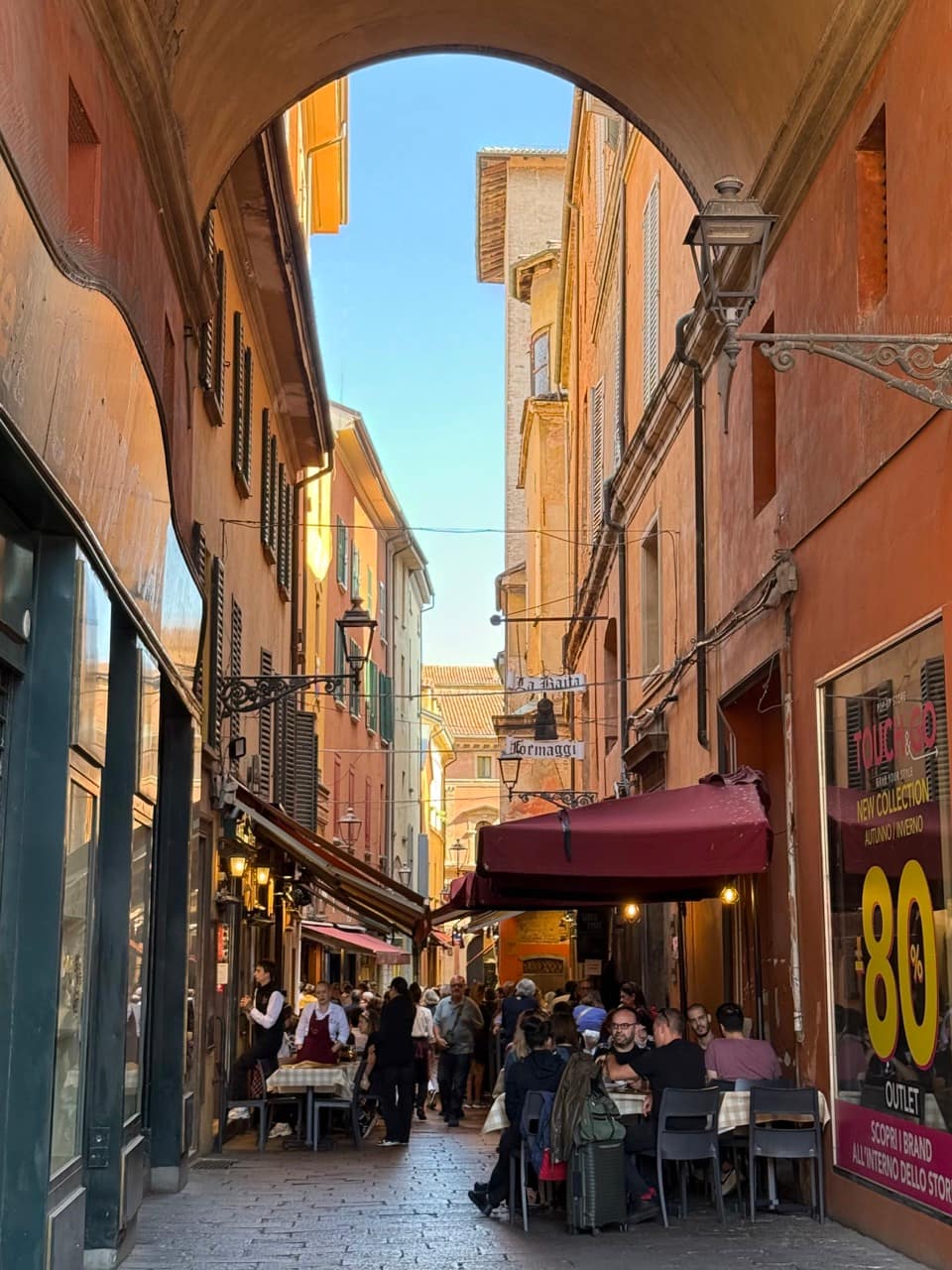
Orange-hued streetscape
Ahead of my journey to Italy, Bologna existed in my mind as an urban city defined by its own airport, its venerable university, and the world-renowned Children’s Book Fair. Leaving Toscana behind, I ventured north into the capital of Emilia-Romagna. Serving merely as a brief stop on my way to Venice, I had only an afternoon to explore. Locals often remark that traveling in Italy is best done by choosing a base and radiating outward. Bologna, I found, is an ideal choice for such explorations, with Modena, Ferrara, and Ravenna all within its orbit. Yet for this one evening, my ambition was modest: to be satiated by an authentic tagliatelle al ragù.
From the moment I arrived, the city revealed itself in sun-washed hues of orange, radiant and alive. As a historic university city, Bologna carries a strong academic presence, its streets populated by students and scholars who lend the city a refined character. Here, the boundary between interior and exterior dissolves, as café tables spill from the rooms onto the sheltered porticoes and out into the open street. To linger amidst the chatter, bathed in sunlight, is perhaps one of the most European rituals.
City of Porticoes
I had long been aware that Bologna’s porticoes were enshrined as a UNESCO World Heritage site, yet it was only upon arrival that I truly comprehended the staggering scale of their embrace. This landscape felt unexpectedly familiar, echoing the arcade culture of Taiwan. While they serve as a reliable refuge on rainy days, their visual language and cultural temperaments are worlds apart. Beneath these vaulted passages here, the experience transcends mere functionality; the continuous revelation of ornamental details, coupled with the act of transit, becomes a rhythmic appreciation of architectural artistry.
Tracing the city’s history, these porticoes originate from the medieval founding of the University of Bologna in 1088, the oldest in the Western world. Soon, the city found itself overwhelmed by a rapid influx of students, triggering a housing crisis. To create additional living space without encroaching on the streets below, landlords extended the upper floors outward, resting them on wooden posts at ground level, a projecting solution that gave birth to the first porticoes.
Intricate carvings adorn the ceiling
Unadorned buttery-yellow vaulting
Column reveals detailed craftsmanship
Brick porticoes line the streets
Piazza del Nettuno & Piazza Maggiore
Navigating through the porticoes and crossing Via Rizzoli, I was greeted by the Two Towers, standing tall as vertical monuments of power, reminiscent of San Gimignano’s medieval skyline. I soon reached Piazza del Nettuno, where the crenelated stonework of Palazzo Re Enzo commands attention. Here, Giambologna’s Neptune sculpture presides over the square, while the steps of the Biblioteca Salaborsa were crowded with students, creating an academic atmosphere. Traversing Piazza Maggiore, the Basilica di San Petronio was alive with activity, its surrounding porticoes lined with cafés. Simply moving between these squares beneath the porticoes immerses me in the spirit of Bolognese life.
Giambologna’s Neptune sculpture
Biblioteca Salaborsa
Round arches along Piazza Maggiore
Two Towers at the end of Via Rizzoli
Biblioteca Comunale dell'Archiginnasio
My journey ended at the Biblioteca Comunale dell’Archiginnasio, a testament to the city’s prominence in law and the sciences. The architecture embodies Renaissance rationalism: a central courtyard and dual-level loggias. The walls and vaults are encrusted with thousands of heraldic coats of arms, reflecting the university’s status as a center of European scholarship. I then entered the Teatro Anatomico; beneath its exquisite chandeliers and within its intricately carved wooden walls, one can still sense the gravity of public dissections performed here in the 17th century. This space marks a turning point in the history of science, when scholars began to study the human body through direct observation rather than relying on ancient texts. No longer a site of instruction, it now stands as one of Bologna’s most distinguished libraries.
Central courtyard and loggias
Frescoes at the entrance
Teatro Anatomico
Second-floor gallery
Osteria dell'Orsa
In the evening, I had searched the map for an authentic restaurant and discovered that Osteria dell’Orsa was a popular spot among locals. Luckily, I only had to wait about twenty minutes before being seated. The staff were warm and welcoming, and the food was delicious, fully satisfying my appetite in Bologna.