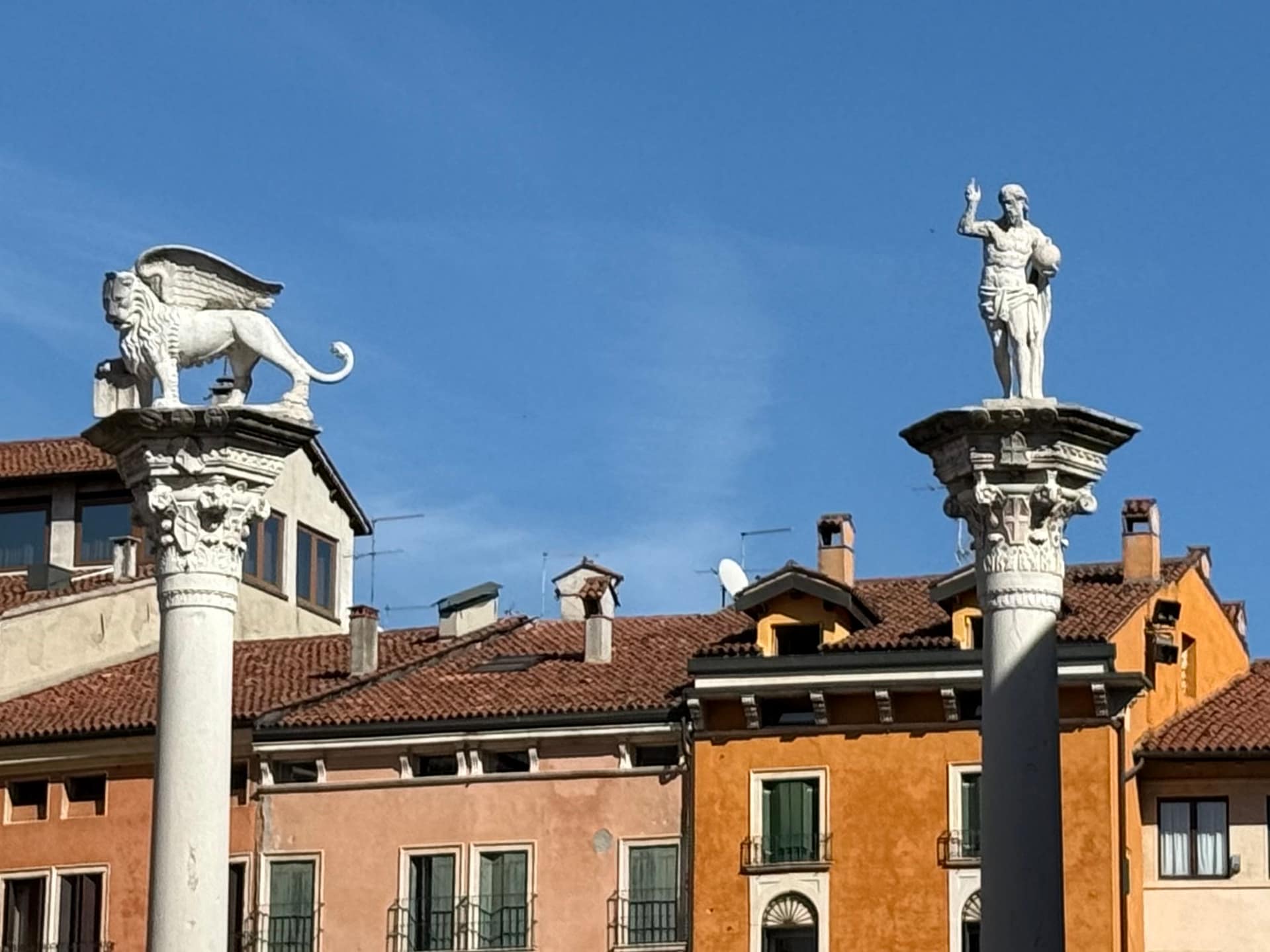
Located a mere hour’s drive from Venice, Vicenza stands as the terrestrial counterpart to its maritime neighbor, its spirit belonging as much to Ancient Rome as to the Venetian Republic. For centuries, the city stood at a strategic crossroads, politically aligned with Venice, yet culturally nourished by the intellectual soil of classical antiquity. In the Piazza dei Signori, the presence of stone columns reminiscent of those in Piazzetta San Marco signals Vicenza’s historical allegiance to Venice. Yet, where Venice dissolves into the poetic fluidity of water and color, Vicenza speaks in a quieter, more measured architectural language defined by proportion, order, and clarity.
St. Mark’s winged lion and Vicenza’s Christ
Palladio’s Grand Stage
Here, in mid-16th century Vicenza, the architect Andrea Palladio found his grand stage. The local aristocracy, seeking to give architectural form to their humanist ideals on land, commissioned Palladio to translate the silent language of Roman antiquity into a living, breathing urban landscape. Grounded in his close reading of Vitruvius’ De Architectura, Palladio understood architecture as an intellectual discipline, governed by proportion, harmony, and reason. In his design vocabulary, every ornamental detail is an obedient servant to the overarching classical order, a philosophy where beauty is the “radiance of truth” found within geometry.
Basilica Palladiana & Loggia del Capitaniato
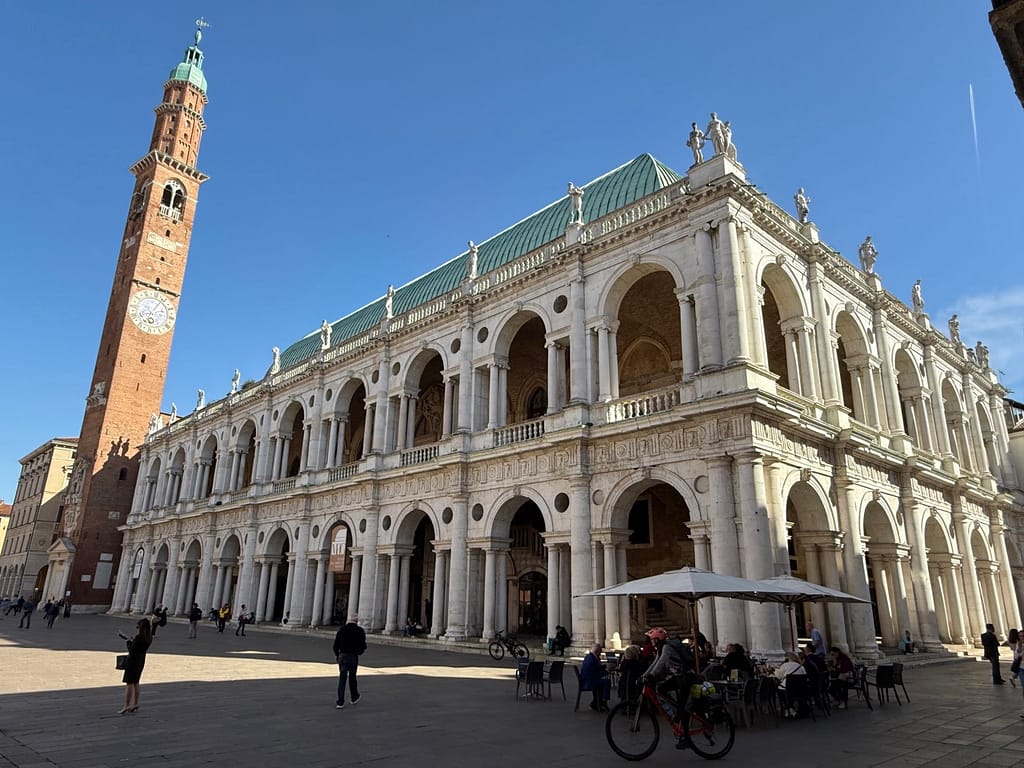
My journey allowed time for only three works that experience the Palladian spirit. In the heart of the city, the Basilica Palladiana stands as Palladio’s breakthrough. Tasked with enveloping a medieval communal palace of asymmetrical proportions, he devised the Serliana motif, later known as the “Palladian Window,” as a rational system of intercolumniation to resolve structural irregularities with rhythmic elegance. Opposite it stands the Loggia del Capitaniato, commissioned by the Venetian captain as a symbol of state authority. Its red brick façade is animated by a powerful giant order, marking the evolution of his style toward a grander, imperial scale. Together, the two buildings stage a dialogue between civic order and political power through proportion rather than monumentality.
Basilica enveloped by ordered arcade
Shadows of statues on the tower
Axially symmetrical Palladian window
Loggia's giant Corinthian columns
Teatro Olimpico
A crowning achievement in architectural history, the Teatro Olimpico is the world’s oldest permanent indoor theater. Commissioned by the Accademia Olimpica, it is a visionary recreation of a Roman streetscape, crafted with masterful forced perspective. Its illusionistic stage sets, designed by Vincenzo Scamozzi after Palladio’s death, create perspectival streets that appear to extend endlessly into an imagined city. Standing within, the theater offers profound visual and acoustic intimacy. As emphasized by a professor of architectural acoustics, it functions as a perfectly tuned instrument: the semi-elliptical seating ensures even sound distribution, while the ornate wooden ceiling and stucco surfaces reflect and resonate with precision. It is a space where architecture is not merely seen, but experienced through sound, movement, and time.
Monumental façade of classical columns
Scamozzi’s urban illusion
Stucco and plaster as stone paradox
Semi-elliptical auditorium
Villa La Rotonda
Among all Palladian works, Villa La Rotonda remains the most profound for me—a sublime expression of the suburban villa ideal, where the city’s intellectual rigor meets the tranquility of the countryside. Named for its central rotunda, radial symmetry unfolds as a meditation on balance. Inspired by Roman temple architecture, most notably the Pantheon, its centralized plan elevates domestic life into a cosmic order.
Stepping inside, a dramatic shift reveals itself: trompe-l’œil frescoes adorn the walls, creating a theatrical illusion that contrasts with Palladio’s structural clarity. Above, rainwater does not fall through an open oculus as in the Pantheon; instead, it is masterfully guided through concealed channels. Centered under the dome, a sculpted grotesque face, together with the radiating marble floors, transforms functional elements into poetic motifs, grounding the visitor at the villa’s geometric heart.
The architecture stands as a collaborative masterpiece. While Palladio dictated proportions and spatial logic, the sculptural details were executed by master craftsmen, and the frescoes were added later, gradually shaping the villa into the historical artifact we experience today. Yet, despite these evolving layers of artistry, the building remains the definitive embodiment of Palladio’s vision: a sublime synthesis of “perfect proportion and harmony.”